
FUPA or Hernia? How to Tell the Difference
Page Contents
- Key Takeaways
- What Is a FUPA?
- A pad of fat over the pubic bone
- How a FUPA feels and behaves
- What Is a Hernia?
- A weak spot in the muscle wall
- Hernias that can appear near the pubic area
- What raises the risk
- FUPA or Hernia: The Main Differences
- Side by side
- The cough and lie-down check
- Where exactly the bulge is
- Other Lumps That Can Look Similar
- Lipomas
- Swollen lymph nodes, cysts and skin problems
- Swelling that comes and goes
- When to Get Medical Help
- See a GP if
- Get urgent help if
- What happens at the appointment
- How Each One Is Treated
- Treating a hernia
- Reducing a FUPA
- Exercise if you have a hernia
- Frequently Asked Questions
- How can I tell if it is a FUPA or a hernia?
- Can a hernia appear above the pubic bone?
- Can a FUPA hide a hernia?
- Does a hernia go away on its own?
- Can losing weight shrink a hernia?
- The Bottom Line
- When in doubt, get it checked
Finding a bulge just above your pubic bone can be worrying. Most of the time it is a FUPA, a pad of fat that many adults have. Sometimes, though, a lump in the same area turns out to be a hernia, which needs checking by a doctor. If you are unsure whether you have a FUPA or hernia, a few simple observations can help you decide how quickly to get it looked at.
This guide explains how a FUPA and a hernia differ, which types of hernia appear near the pubic area, the cough test, and the warning signs that mean you should get help straight away. It is part of our guide to hormonal belly fat and health conditions.
This guide is general information, not medical advice. It cannot diagnose a hernia or any other condition. If you notice a new lump, or a lump that hurts or is changing, speak to your GP.
Key Takeaways
- A FUPA is soft fat spread evenly across the mons pubis. It does not change when you cough and does not disappear when you lie down.
- A hernia happens when part of an organ, such as the bowel, pushes through a weak spot in the muscle wall. It often shows as a defined lump.
- Groin hernias usually sit to one side, where the leg meets the tummy, rather than in the centre of the pubic area.
- A hernia lump may grow when you cough, strain or stand and shrink when you lie down.
- Pain in a hernia, sickness, a bloated tummy or being unable to poo or fart are urgent warning signs.
What Is a FUPA?
A pad of fat over the pubic bone
A FUPA is a build up of subcutaneous fat on the mons pubis, the rounded area that sits over the pubic bone. It can be more noticeable after weight gain, pregnancy or weight loss that leaves loose skin. Our guide to what a FUPA is covers the anatomy in more detail.
How a FUPA feels and behaves
A FUPA feels soft and squashy, and you can pinch it between your fingers. It usually spreads evenly across the middle of the pubic area rather than forming a separate lump. It looks the same when you stand, sit or lie down, it does not change when you cough, and it is normally painless unless the skin is rubbing or sore.
What Is a Hernia?
A weak spot in the muscle wall
The NHS hernia guide describes a hernia as part of an internal organ, such as the bowel, pushing through a gap or weak area in the muscle that keeps your organs in place. Most hernias develop in the tummy or groin. Some cause a lump you can see or feel, while others are internal.
Hernias that can appear near the pubic area
- Inguinal hernia: the most common groin hernia, where the leg joins the tummy. It usually sits to one side and can extend down towards the scrotum or labia. It is much more common in men.
- Femoral hernia: a small lump at the top of the thigh, in the groin, often about the size of a grape. The NHS says these mainly happen in women over 50.
- Incisional hernia: a bulge through or near a surgical scar, such as a caesarean section or other lower tummy operation.
- Umbilical hernia: a bulge under or near the belly button, higher up than a FUPA.
What raises the risk
Anything that puts repeated pressure on the tummy wall can make a hernia more likely. The NHS lists straining to poo, lifting heavy weights, being overweight, a long-term cough, pregnancy and losing weight very quickly as causes of a femoral hernia, and similar pressures apply to other types.
FUPA or Hernia: The Main Differences
Side by side
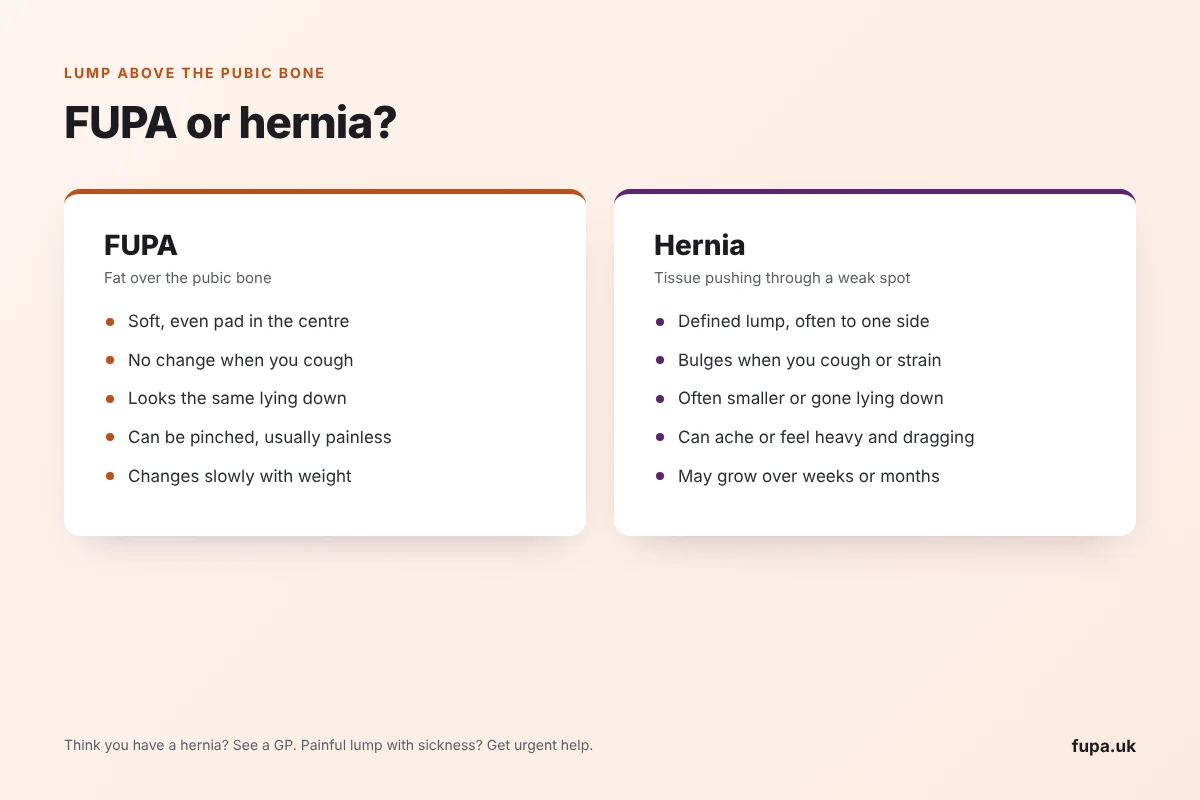
| Feature | FUPA | Hernia |
|---|---|---|
| Where it sits | Centre of the pubic mound, spread evenly | Often one side of the groin, upper thigh or near a scar |
| Shape | Broad, soft pad with no clear edge | Defined lump or bulge |
| When you cough or strain | No change | Often bulges out or feels a push |
| When you lie down | Looks much the same | Often smaller or disappears |
| Feel | Soft, pinchable fat | Can feel firm, tight or stretched |
| Pain | Usually painless | Can ache, drag or hurt, especially when lifting |
| Change over time | Slowly, with weight | Can grow over weeks or months |
The cough and lie-down check
Stand in front of a mirror and rest your fingers lightly on the area. Cough firmly. If a lump pushes out or you feel a distinct bulge against your fingers, that is typical of a hernia. Then lie flat on your back for a minute. A hernia lump often gets smaller or disappears in this position, while a FUPA looks and feels much the same. Do not press hard or try to push a lump back in yourself. This check helps you describe what you notice to a GP. It does not rule a hernia in or out.
Where exactly the bulge is
Position is a strong clue. A FUPA sits in the middle, directly over the pubic bone, and usually looks the same on both sides. A lump that sits to one side, in the crease where the leg meets the body, or just below it at the top of the thigh, is more typical of a groin hernia. A bulge along an old scar, such as a C-section scar, may be an incisional hernia.
Other Lumps That Can Look Similar
Lipomas
A lipoma is a soft, rubbery lump of fat that moves slightly under the skin. It does not change when you cough. Our guide on a FUPA or a lipoma explains how to tell these apart.
Swollen lymph nodes, cysts and skin problems
Glands in the groin can swell with an infection and feel like small, tender lumps. Cysts and infected hair follicles can also form on the pubic area, especially after shaving. Our page on FUPA pain and irritation covers common skin causes.
Swelling that comes and goes
Bloating can make the lower tummy look bigger at the end of the day, but it affects the whole lower belly rather than forming one lump. Our guide to FUPA vs other belly fat compares the main causes of a bigger lower belly.
When to Get Medical Help
See a GP if
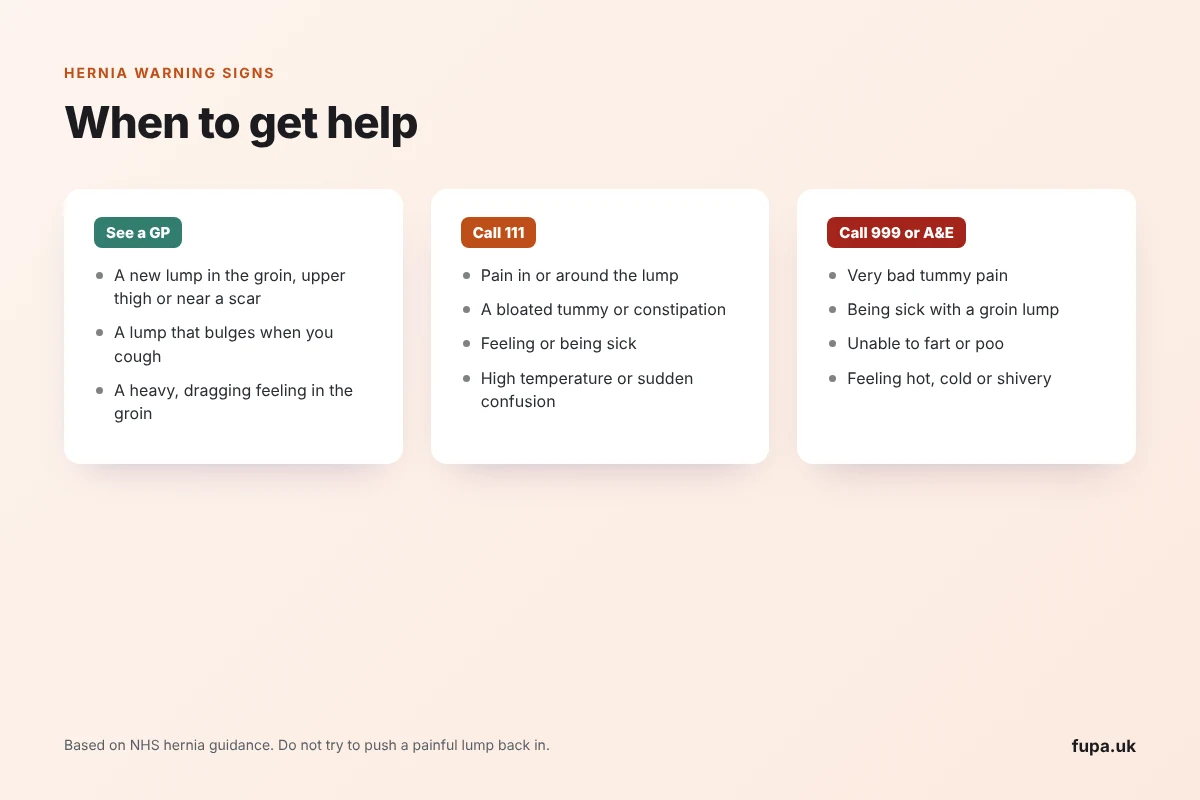
The NHS advises seeing a GP if you think you have a hernia. Book an appointment if you notice:
- a new lump in your groin, upper thigh, belly button or near a scar
- a lump that gets bigger when you cough or strain and smaller when you lie down
- a heavy, dragging feeling in the groin
- any lump you are unsure about, even if it does not hurt
Get urgent help if
If you have a hernia, or think you might, the NHS advises getting help from 111 if you have pain in or around the lump, a bloated tummy, feel or are being sick, are constipated, have a high temperature or have suddenly become confused. A trapped hernia can cut off the blood supply to the tissue inside it (strangulation) or block the bowel, which needs emergency surgery.
For a femoral hernia, the NHS femoral hernia page says to call 999 or go to A&E if you have very bad tummy pain, are being sick, cannot fart or poo, or feel hot and shivery.
What happens at the appointment
A GP will usually ask about your symptoms and examine the area while you stand and lie down, and may ask you to cough. If the diagnosis is unclear, they may arrange an ultrasound scan or refer you to a surgeon.
How Each One Is Treated
Treating a hernia
Treatment depends on the type of hernia and your symptoms. The NHS explains that an inguinal hernia that causes no symptoms may not need treatment, while surgery is recommended for a femoral hernia because it rarely gets better on its own. Repairs can be done by keyhole or open surgery, and recovery usually takes around 4 to 6 weeks, with no heavy lifting during that time. Losing weight, if you are overweight, can also help.
Reducing a FUPA
A FUPA is not dangerous and needs no treatment unless it bothers you. It responds slowly to overall fat loss through a calorie deficit, regular activity and strength training. Our guide on how to get rid of a FUPA sets out a realistic plan.
Exercise if you have a hernia
Do not start heavy lifting or intense core work until a doctor has checked a suspected hernia. Gentle walking is usually fine, but ask your GP or surgeon which exercises are safe for you, especially in the weeks after a repair.
Frequently Asked Questions
How can I tell if it is a FUPA or a hernia?
A FUPA is soft, even fat across the middle of the pubic area that stays the same when you cough or lie down. A hernia is usually a defined lump, often to one side, that bulges when you cough and shrinks when you lie down. A GP can confirm which it is.
Can a hernia appear above the pubic bone?
Yes. Groin hernias appear where the leg meets the tummy, just to the side of the pubic bone, and an incisional hernia can form through a scar low on the tummy, such as a caesarean scar.
Can a FUPA hide a hernia?
A thick layer of fat can make a small hernia harder to see or feel. If you notice a new bulge, a dragging feeling or pain in the groin, see a GP even if you cannot find a clear lump.
Does a hernia go away on its own?
Some hernias do not cause problems, but most do not go away by themselves. The NHS advises seeing a GP if you think you have one, and surgery is recommended for femoral hernias.
Can losing weight shrink a hernia?
Weight loss will not close the weak spot in the muscle, but the NHS lists losing weight, if you are overweight, as one of the treatments for a hernia. It can reduce pressure on the tummy wall and may lower the risk of some hernias.
The Bottom Line
When in doubt, get it checked
A FUPA is a soft, even pad of fat in the centre of the pubic area that does not change when you cough or lie down. A hernia is usually a distinct lump, often to one side, that comes and goes with pressure. If you are unsure, a quick GP check is the safest step, and any painful lump with sickness or bowel changes needs urgent help. For other causes of lower belly changes, see our hub on hormonal belly fat and health conditions.