
Postnatal Exercises for Your Lower Belly: A Safe Progression
Page Contents
- Key Takeaways
- Why the Lower Belly Needs a Careful Restart
- What pregnancy does to your core
- Why the “mummy tummy” sits low
- Stage 1: The First Days and Weeks
- Pelvic floor exercises
- The gentle deep tummy draw-in
- Short, easy walks
- Daily habits that protect the lower belly
- Stage 2: From the 6 to 8 Week Check
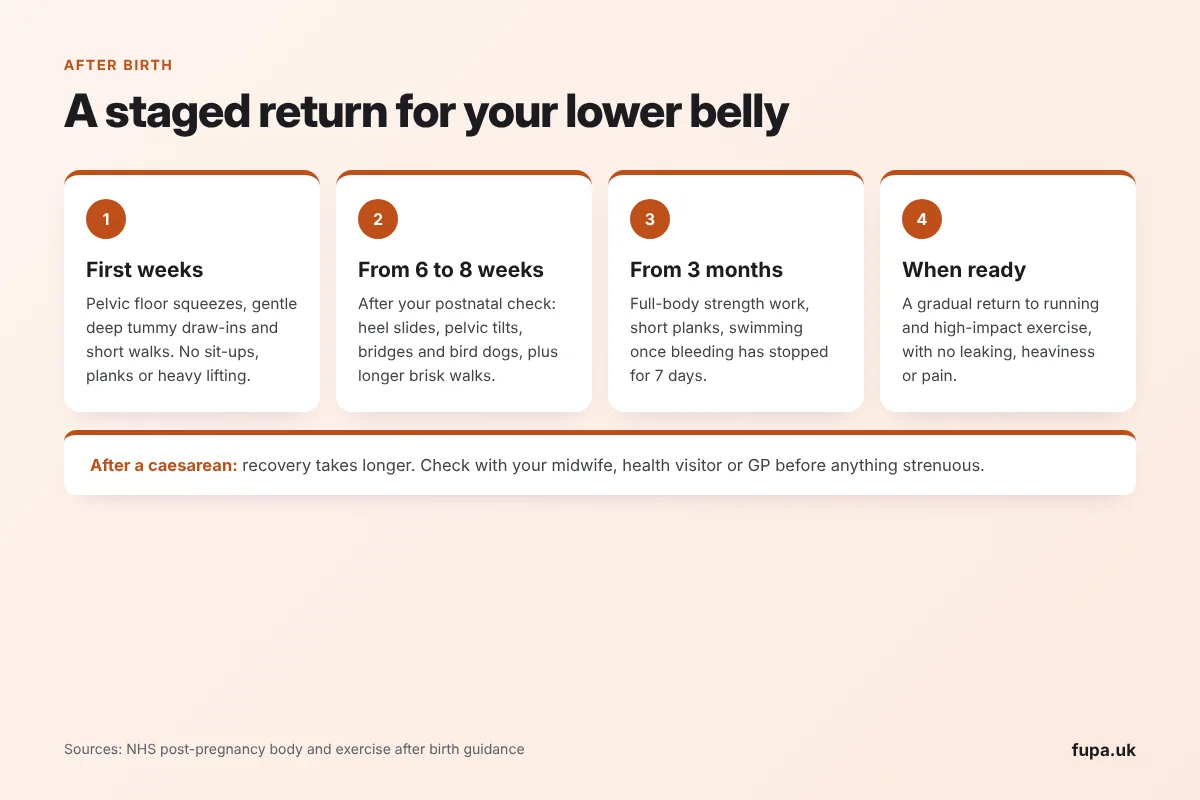
- Use your postnatal check
- Check your tummy gap
- Low-impact core moves to add
- Stage 3: Building Strength From Around 3 Months
- Add strength training for the whole body
- Return to harder core work slowly
- Running and other high-impact exercise
- Swimming and classes
- Postnatal Exercises After a C-Section
- Why the timeline is longer
- Protecting the scar
- A Simple Postnatal Lower Belly Timeline
- When to Get Help
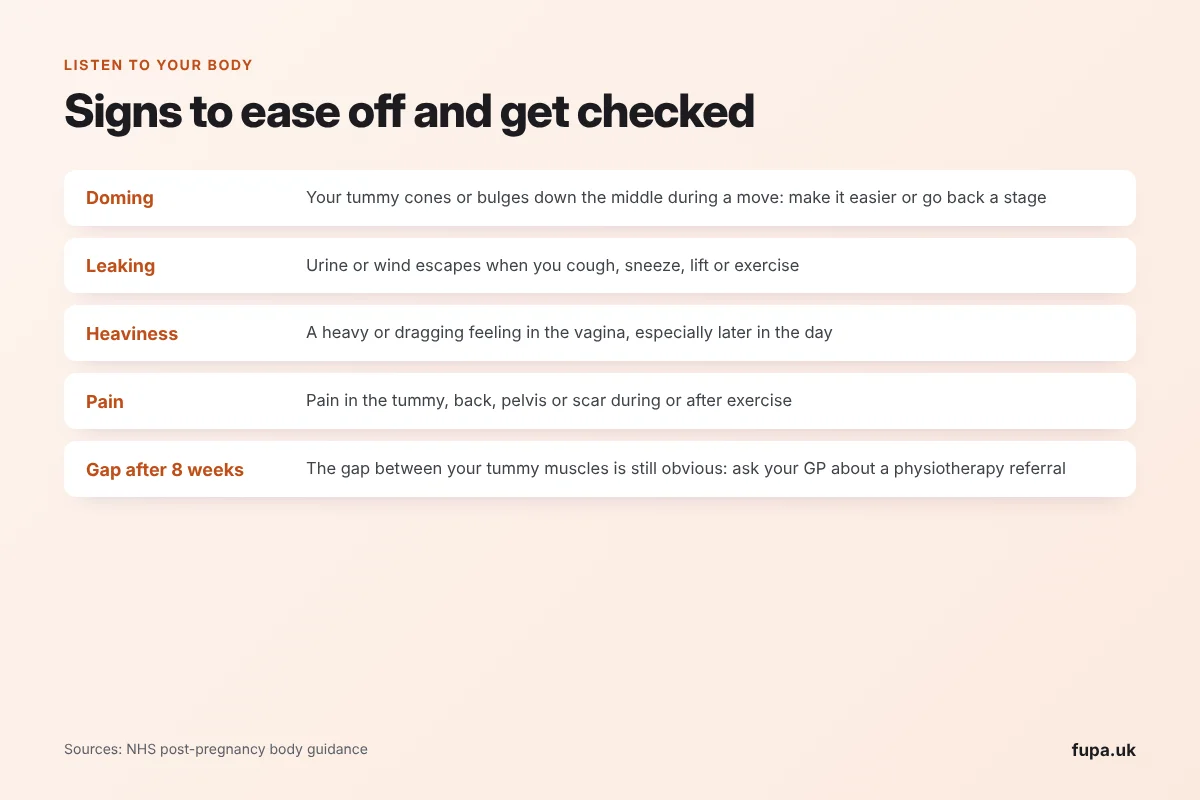
- Symptoms to mention to your GP
- Look after the rest of your recovery
- Frequently Asked Questions
- When can I start exercising my lower belly after giving birth?
- What is the best postnatal exercise for a mummy tummy?
- Can I do sit-ups or planks after having a baby?
- How soon can I exercise after a C-section?
- Will postnatal exercises get rid of my lower belly pouch?
- The Bottom Line
- Rebuild from the inside out
Postnatal exercises for the lower belly are one of the first things many new mums search for once the newborn fog starts to lift. After nine months of stretching, the muscles and tissues of the lower tummy and pelvic floor have been through a lot, and the soft pouch that sits low on the belly can feel stubborn. The good news is that the right exercises, done in the right order, rebuild strength safely and help the lower belly look and feel firmer over time.
This guide sets out a staged plan, from gentle pelvic floor work in the first days to fuller core and strength training months later. It explains what to avoid early on, how a caesarean changes the timeline and when to ask for help. It is part of our weekly workout plan for belly fat.
This guide is general information, not medical advice. Always follow the advice of your midwife, health visitor, GP or physiotherapist. Stop and get checked if you have pain, heavy bleeding, leaking, a heavy or dragging feeling in the vagina, or a wound that is red, hot or leaking.
Key Takeaways
- Start with the foundations: pelvic floor exercises and gentle deep tummy draw-ins can begin in the first days after a straightforward birth.
- The NHS advises avoiding sit-ups, planks and high-impact exercise at first, and getting advice at your 6 week postnatal check before running or aerobics.
- A gap between the tummy muscles, called diastasis recti, usually closes by the time your baby is 8 weeks old. If it is still obvious after that, see your GP.
- After a caesarean, recovery takes longer, so speak to your midwife, health visitor or GP before anything strenuous.
Why the Lower Belly Needs a Careful Restart
What pregnancy does to your core
During pregnancy, the long muscles down the front of the tummy stretch and move apart to make room for your baby. The deep tummy muscle that wraps round your middle like a corset, called the transverse abdominis, is stretched too. At the same time, the pelvic floor carries the growing weight of the womb and, after a vaginal birth, is stretched further during delivery. The NHS notes that ligaments stay more flexible for a few months after birth, so over-stretching and twisting are more likely to cause injury.
Why the “mummy tummy” sits low
The lower belly often stays rounder than the upper belly after birth. Part of this is stretched muscle and skin, part is the womb shrinking back over several weeks, and part is fat stored during pregnancy. Many women also notice a soft pad of fat over the pubic bone, called a FUPA. Our guide to a FUPA after pregnancy explains why this area changes and how long it can take to settle.
Stage 1: The First Days and Weeks
Pelvic floor exercises
The NHS guidance on your post-pregnancy body recommends pelvic floor exercises after birth. Squeeze and draw in around your back passage, then around your vagina and bladder, as if stopping wind and a wee at the same time. Practise long squeezes, holding for up to 10 seconds before relaxing, and short quick squeezes. Aim to build up to 10 repeats of each, at least 3 times a day. Keep breathing normally and do not pull in your stomach or hold your breath. You can do them lying down, sitting or standing, so they fit easily into feeds.
The gentle deep tummy draw-in
The NHS also describes a simple stomach exercise for the deep core. Lie on your side with your knees slightly bent. Relax your tummy and breathe in gently. As you breathe out, gently draw in your lower stomach, narrowing your waist, and squeeze your pelvic floor at the same time. Hold for a count of 10 while breathing normally, then release. Repeat up to 10 times. This is the first true lower belly exercise, and it teaches the deep muscles to switch on before you add load.
Short, easy walks
After a straightforward vaginal birth, the NHS says you can start gentle exercise as soon as you feel up to it, such as walking, gentle stretches and pelvic floor exercises. Begin with a few minutes around the house or to the end of the road, and build up slowly. Walking with the pram counts.
Daily habits that protect the lower belly
Early on, how you move matters as much as any exercise. The NHS advises avoiding straining on the toilet and heavy lifting at first. When you lift your baby or a car seat, bend your knees rather than your waist and hold the weight close to your body. To get out of bed, roll onto your side first and push up with your arms rather than sitting straight up, which loads the front of the tummy.
Stage 2: From the 6 to 8 Week Check
Use your postnatal check
Your GP postnatal check happens around 6 to 8 weeks after the birth. It is a good moment to mention leaking, pain, a heavy feeling in the vagina, a bulge down the middle of your tummy or anything else that is bothering you. The NHS says to get advice at this check before starting high-impact exercise such as aerobics or running.
Check your tummy gap
The NHS explains that diastasis recti is when the two stomach muscles separate during pregnancy, usually by about 2 finger widths, and that the gap usually goes back to normal by the time your baby is 8 weeks old. To check it, lie on your back with your knees bent, lift your shoulders slightly off the floor and feel above and below your belly button with your fingertips. If the gap is still obvious 8 weeks after the birth, contact your GP, who can refer you to a physiotherapist. Our guide to a FUPA vs diastasis recti explains how to tell a muscle gap from a fat pad.
Low-impact core moves to add
Once you feel ready and have had no warning signs, these moves build on the deep draw-in. Keep each one slow and controlled, and breathe out on the effort.
- Heel slides: lie on your back with knees bent, draw in your lower tummy, then slowly slide one heel away along the floor and back without your back arching. 8 to 10 each side.
- Pelvic tilts: on your back with knees bent, gently flatten your lower back into the floor by tilting your pelvis, then release. 10 slow repeats.
- Glute bridges: squeeze your pelvic floor, then lift your hips until your body forms a line from shoulders to knees, and lower slowly. 8 to 12 repeats.
- Bird dog: on hands and knees, reach one arm and the opposite leg out long without your back sagging, then swap. 6 to 8 each side.
Watch your tummy as you work. If it domes, cones or bulges down the middle, make the move easier or go back a step. Our guide to lower ab exercises has more form cues for these moves.
Stage 3: Building Strength From Around 3 Months
Add strength training for the whole body
Once your core and pelvic floor feel steady, full-body strength work does more for your lower belly than endless ab moves. Squats to a chair, split squats, rows with a resistance band, wall press-ups and hip thrusts all train large muscle groups while asking your core to brace. Start with your body weight or light weights and add a little more as the moves get easy. Our guide to strength training for belly fat has a simple routine to follow.
Return to harder core work slowly
Front planks, side planks and dead bugs can come back once you can do the stage 2 moves without doming, leaking or pain. Start with short holds of 10 to 20 seconds, on your knees if needed, and build up over weeks. Traditional sit-ups and crunches are not the best place to begin. Our page on whether crunches burn belly fat explains why they are a poor choice for shrinking the belly anyway.
Running and other high-impact exercise
UK physiotherapy guidance on returning to running after childbirth, published by pelvic health physiotherapists and recognised by the Chartered Society of Physiotherapy, advises a gradual, staged return rather than a fixed date. It suggests that for most women the earliest sensible point to start running again is around 3 to 6 months after birth, after a period of low-impact exercise and strength work. Before you run, you should be able to walk briskly for 30 minutes, hop and jog on the spot without leaking, heaviness or pain. If any of these cause symptoms, a pelvic health physiotherapist can help.
Swimming and classes
The NHS says to wait until 7 days after your postnatal bleeding has stopped before swimming. Our guide to Pilates for lower belly fat covers a gentle routine that suits many new mums.
Postnatal Exercises After a C-Section
Why the timeline is longer
A caesarean is major abdominal surgery. The NHS says recovery takes longer after a caesarean or complicated delivery, and that you should talk to your midwife, health visitor or GP before starting anything strenuous. Pelvic floor exercises and gentle walking are usually still encouraged early on, because the pelvic floor has carried the pregnancy even if the birth was not vaginal.
Protecting the scar
Support your wound with a hand or a small pillow when you cough, laugh or get up. Gentle deep tummy draw-ins can usually start once they feel comfortable, but anything that strains the front of the tummy should wait until your team is happy. The low scar can also leave a small overhang above it. Our guide to a FUPA after a C-section explains why this happens and what helps.
A Simple Postnatal Lower Belly Timeline
Every recovery is different, so use this as a guide rather than a deadline. Move to the next stage only when the current one feels easy and symptom free.
| Stage | Rough timing | Focus | Hold back on |
|---|---|---|---|
| Stage 1 | First days to 6 weeks | Pelvic floor squeezes, deep tummy draw-ins, short walks, good lifting habits | Sit-ups, planks, heavy lifting, high-impact exercise |
| Stage 2 | From the 6 to 8 week check | Heel slides, pelvic tilts, bridges, bird dogs, longer brisk walks | Running and jumping until checked |
| Stage 3 | From around 3 months | Full-body strength training, short planks, swimming, classes | Fast progressions if you notice doming, leaking or heaviness |
| Stage 4 | When strength and symptoms allow | Gradual return to running, HIIT and sport | Pushing through pain or pelvic floor symptoms |
When to Get Help
Symptoms to mention to your GP
See your GP or ask for a physiotherapy referral if you leak urine or wind when you cough, sneeze or exercise, feel a heavy or dragging feeling in the vagina, have pain during or after exercise, or still have an obvious tummy gap 8 weeks after the birth. The NHS says a GP or health visitor can refer you to a specialist if needed. These problems are common and treatable, so there is no need to put up with them.
Look after the rest of your recovery
Broken sleep, feeding and stress all affect energy and appetite. For weight loss while breastfeeding, the NHS suggests a brisk 30 minute walk each day alongside a healthy, balanced diet. Gradual changes are kinder than strict diets in the early months. Our guide on how long it takes to lose lower belly fat sets realistic expectations.
Frequently Asked Questions
When can I start exercising my lower belly after giving birth?
After a straightforward vaginal birth, the NHS says you can start gentle exercise such as walking, stretches and pelvic floor exercises as soon as you feel up to it. Gentle deep tummy draw-ins can start early too. Wait for your 6 week postnatal check before high-impact exercise such as running or aerobics.
What is the best postnatal exercise for a mummy tummy?
The best starting point is the deep tummy draw-in combined with a pelvic floor squeeze, as described by the NHS. It trains the corset-like transverse abdominis that supports the lower belly. Heel slides, pelvic tilts, bridges and bird dogs build on it once you feel ready.
Can I do sit-ups or planks after having a baby?
The NHS advises avoiding sit-ups, planks and high-impact exercise at first. Bring planks back gradually once you can do gentle core moves without your tummy doming, leaking or pain. Sit-ups are rarely needed and are not the best way to strengthen the lower belly.
How soon can I exercise after a C-section?
Recovery takes longer after a caesarean, so talk to your midwife, health visitor or GP before anything strenuous. Pelvic floor exercises and gentle walking are usually fine early on. Harder core work and high-impact exercise should wait until your team is happy with your healing.
Will postnatal exercises get rid of my lower belly pouch?
They strengthen the muscles under the pouch, which can make it look flatter, but they will not burn fat from that spot. The fat part shrinks with overall fat loss over months. Loose skin may not fully tighten, and a muscle gap that stays open after 8 weeks needs a GP or physiotherapist check.
The Bottom Line
Rebuild from the inside out
Postnatal exercises for the lower belly work best as a slow, staged plan. Start with pelvic floor squeezes and deep tummy draw-ins, add walking, then move to low-impact core moves after your 6 to 8 week check and full-body strength work from around 3 months. Hold back on sit-ups, planks and running until your body is ready, and get help for leaking, heaviness or a lasting tummy gap. For the full week of training once you are fully recovered, see our belly fat workout plan.