
Strength Training for Belly Fat: Weights vs Cardio
Page Contents
- Key Takeaways
- Does Strength Training Burn Belly Fat?
- What the research shows
- Why the scales can mislead you
- You still cannot spot reduce
- Weights vs Cardio for Belly Fat
- The STRRIDE trial
- What each group achieved
- What that means for you
- Why Muscle Matters When You Are Losing Fat
- Protecting muscle in a calorie deficit
- Resting metabolism: a small but real effect
- Muscle loss with age
- How Much Strength Training Do You Need?
- The NHS guidelines
- What counts as strength training
- Sets, reps and rest
- Strength Training for Belly Fat: The Best Exercises
- Big compound lifts
- Core work to finish
- If the floor is hard for you
- A Weekly Plan That Combines Weights and Cardio
- Choosing your cardio
- Starting from scratch
- Diet Still Does Most of the Work
- Why training alone is not enough
- Fuel your sessions
- Common Mistakes to Avoid
- Lifting too light for too long
- Doing endless ab exercises
- Judging progress by weight alone
- Frequently Asked Questions
- Is strength training or cardio better for belly fat?
- Can lifting weights alone get rid of belly fat?
- How many days a week should I lift weights to lose belly fat?
- Will strength training make my waist bigger?
- Why am I not losing weight after starting weights?
- The Bottom Line
- Use weights and cardio together
Strength training for belly fat works, but not in the way most people expect. Lifting weights does not burn fat from your stomach directly, and on its own it usually burns fewer calories per session than running or cycling. What it does is protect and build muscle while you lose fat, so more of the weight you lose comes from fat and your shape changes even when the scales move slowly. The best results come from combining weights, cardio and a modest calorie deficit.
This guide compares weights and cardio for belly fat, explains what the research actually shows, and gives you a simple weekly plan that uses both. It is part of our wider weekly workout plan for belly fat.
This guide is general information, not medical advice. If you have a heart condition, high blood pressure, joint problems, are pregnant or recently gave birth, or have not exercised for a long time, check with your GP before starting a new training programme.
Key Takeaways
- Strength training reduces body fat and visceral fat on its own, but the effect is modest without changes to diet.
- Cardio burns more calories per session, so it tends to lower weight and fat mass faster in the short term.
- Weights build or keep muscle, which matters most when you are eating less or getting older.
- A mix of both gave the best overall change in body composition in a large randomised trial.
- The NHS advises strength work on at least 2 days a week on top of 150 minutes of moderate activity.
Does Strength Training Burn Belly Fat?
What the research shows
A 2022 systematic review and meta-analysis in Sports Medicine pooled 58 randomised trials of full body resistance training in healthy adults. Compared with people who did no exercise, those who trained with weights for at least four weeks lowered their body fat percentage by about 1.46 percentage points and lost around half a kilogram of fat mass on average. Visceral fat, the deeper fat around the organs, also fell. The participants were not asked to diet, so these changes came from training alone.
Why the scales can mislead you
Strength training adds muscle while it removes fat, so your weight may barely change even though your waist gets smaller. Tracking your waist measurement, how your clothes fit and progress photos tells you far more than the scales. Our guide on how to measure a FUPA shows a simple way to track change at home.
You still cannot spot reduce
Weights do not let you choose where fat comes off. Training your abs builds the muscle under the fat but does not burn the fat sitting on top of it. Belly fat, including the softer fat over the lower belly, falls as overall body fat falls. Our guide on how to burn lower belly fat explains why.
Weights vs Cardio for Belly Fat
The STRRIDE trial
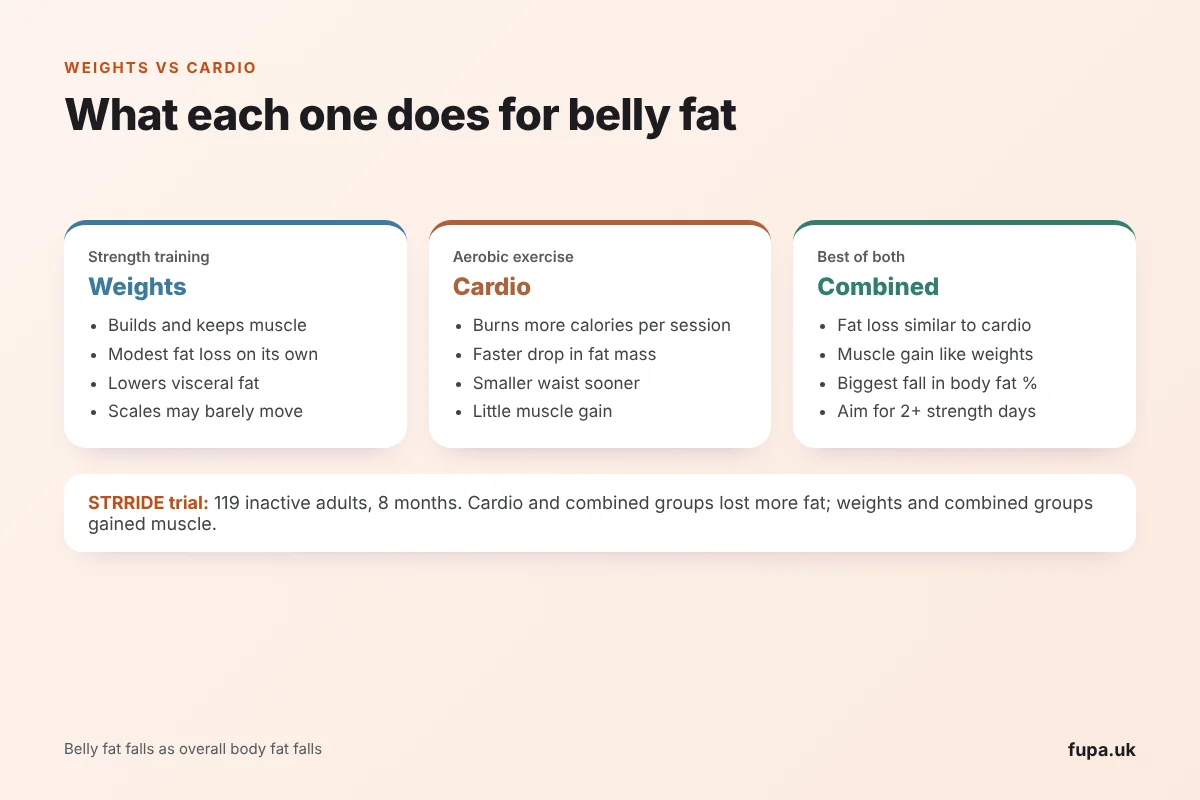
The most useful head to head comparison is the STRRIDE AT/RT trial, published in the Journal of Applied Physiology in 2012. It followed 119 inactive adults living with overweight or obesity for eight months. One group did aerobic exercise at a vigorous intensity, about 45 minutes three days a week. One group lifted weights three days a week, doing three sets of 8 to 12 repetitions on eight machines. A third group did both.
What each group achieved
- Cardio only: lost more body weight, fat mass and waist size than the weights group, but did not gain muscle.
- Weights only: gained lean mass and strength, but fat mass and waist size did not change much over the study.
- Both combined: lost about as much fat as the cardio group and gained muscle as well, so body fat percentage fell the most.
What that means for you
If you only have time for one type of exercise and your main aim is fat loss, cardio has the edge. If you can fit in both, the combination improves your body composition the most. Weights are also the only option of the two that reliably builds strength and muscle, which brings benefits that go well beyond the waistline.
Why Muscle Matters When You Are Losing Fat
Protecting muscle in a calorie deficit
When you eat less to lose weight, your body breaks down some muscle as well as fat. Strength training sends a clear signal to keep that muscle. Pairing weights with enough protein means more of the weight you lose comes from fat. Our guide to protein for fat loss covers how much to aim for.
Resting metabolism: a small but real effect
Muscle uses a little more energy at rest than fat does, so building muscle nudges up the calories you burn each day. The effect is smaller than many fitness claims suggest, and it will not cancel out overeating. Its main value is in limiting the slowdown that often comes with dieting and ageing.
Muscle loss with age
Adults gradually lose muscle from middle age onwards, which can make it easier to gain fat around the middle. Regular strength training slows this loss and helps with balance, bone strength and everyday tasks like carrying shopping or climbing stairs.
How Much Strength Training Do You Need?
The NHS guidelines
The NHS physical activity guidelines advise adults aged 19 to 64 to do strengthening activities that work all the major muscle groups (legs, hips, back, abdomen, chest, shoulders and arms) on at least 2 days a week. That sits on top of at least 150 minutes of moderate activity or 75 minutes of vigorous activity a week.
What counts as strength training
- Lifting free weights such as dumbbells, kettlebells or barbells.
- Resistance machines at a gym.
- Bodyweight exercises such as squats, press ups and lunges.
- Resistance bands at home.
- Heavy gardening such as digging, and carrying heavy shopping.
Sets, reps and rest
For most beginners, two or three sets of 8 to 12 repetitions per exercise is a sensible starting point. Choose a weight that makes the last two or three reps feel hard while your form stays clean. Rest about a minute between sets. When 12 reps start to feel easy, increase the weight slightly. This gradual increase is called progressive overload, and it is what drives results.
Strength Training for Belly Fat: The Best Exercises
Big compound lifts
Exercises that use several large muscle groups at once burn more energy and build more muscle than small isolation moves. Prioritise these:
- Squats or goblet squats for the legs and glutes. Our guide on whether squats shrink a FUPA covers what they can and cannot do.
- Deadlifts or Romanian deadlifts for the back of the legs and the lower back.
- Hip thrusts or glute bridges, which our guide to hip thrusts for a FUPA explains in detail.
- Rows for the upper back.
- Press ups or chest presses for the chest, shoulders and arms.
Core work to finish
Add one or two core exercises at the end of each session, such as planks, dead bugs or reverse crunches. They strengthen the muscles that support your posture and lower back. Our guide to lower ab exercises shows good form for each.
If the floor is hard for you
If getting up and down is difficult because of your size, back pain or recent pregnancy, standing moves with dumbbells or bands work well. Our guide to standing ab exercises is a gentle place to start.
A Weekly Plan That Combines Weights and Cardio
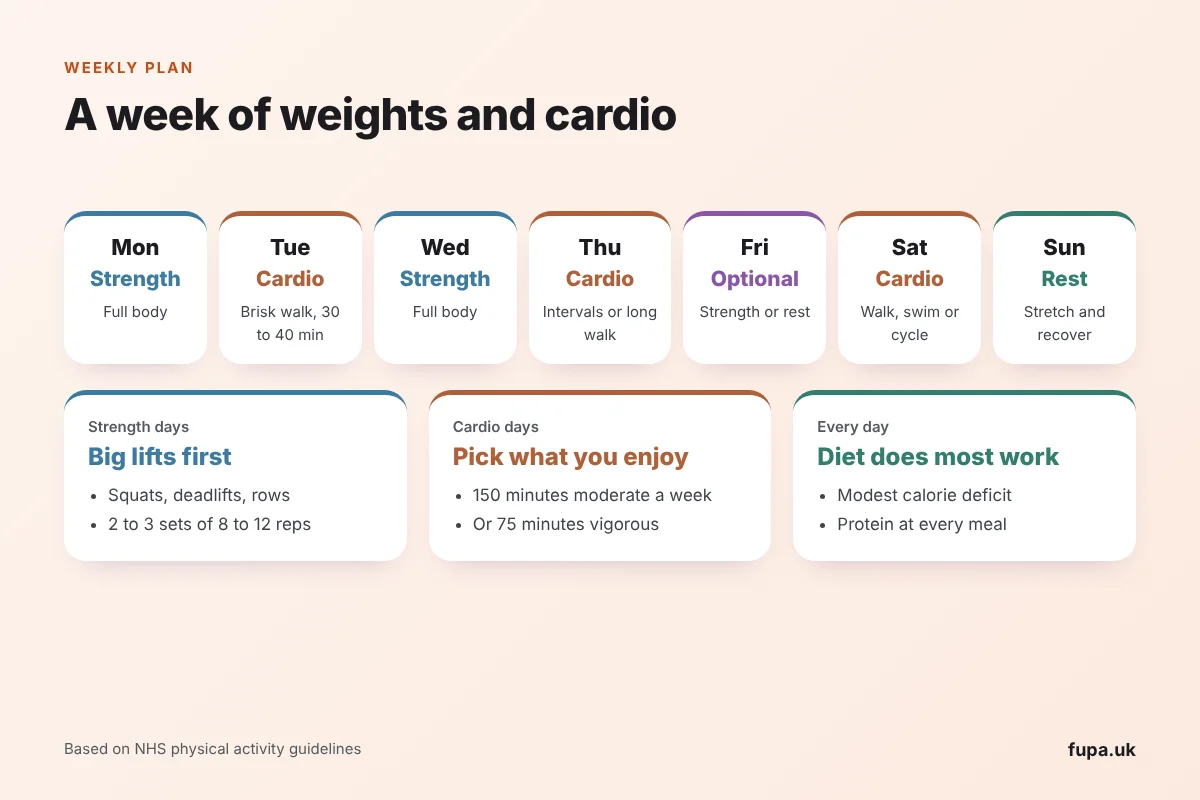
This plan meets the NHS guidelines and follows what the research suggests works best for body composition.
| Day | Session | Time |
|---|---|---|
| Monday | Full body strength: squats, rows, press ups, plank | 40 to 45 minutes |
| Tuesday | Brisk walk or easy cycle | 30 to 40 minutes |
| Wednesday | Full body strength: Romanian deadlifts, hip thrusts, chest press, dead bugs | 40 to 45 minutes |
| Thursday | Cardio intervals or a longer brisk walk | 20 to 40 minutes |
| Friday | Optional third strength session or rest | 30 to 40 minutes |
| Saturday | Longer walk, swim or bike ride | 45 to 60 minutes |
| Sunday | Rest and gentle stretching | As you like |
Choosing your cardio
Both steady cardio and interval training reduce body fat, so pick the type you enjoy and can repeat. Our comparison of HIIT vs steady cardio for a FUPA sets out the pros and cons of each.
Starting from scratch
If you are new to exercise, begin with two short strength sessions and daily walks for the first few weeks. Add time or a third session once you recover easily between workouts. Slow, steady progress beats an ambitious plan you abandon after a fortnight.
Diet Still Does Most of the Work
Why training alone is not enough
The fat loss from training alone in the research above was real but modest. To see a clear change in your belly, you also need to eat a little less than your body uses. A steady calorie deficit, enough protein and plenty of fibre make the biggest difference. Our guide to a calorie deficit for a FUPA shows how to set yours.
Fuel your sessions
Very low calorie diets leave you tired and make heavy lifting harder. Aim for a moderate deficit, eat a meal with protein and carbohydrate a few hours before training, and drink water through the session.
Common Mistakes to Avoid
Lifting too light for too long
Weights that never feel challenging give your muscles no reason to adapt. Increase the load gradually as you get stronger.
Doing endless ab exercises
Hundreds of crunches build a little muscle but burn few calories. Time spent on big lifts and cardio does more for belly fat.
Judging progress by weight alone
Because muscle is gained while fat is lost, the scales can stall even while your waist shrinks. Measure your waist every week or two at the same time of day. Our guide on the best exercises for lower belly fat ranks other moves worth adding.
Frequently Asked Questions
Is strength training or cardio better for belly fat?
Cardio usually burns more calories per session and lowers fat mass faster. Strength training builds and protects muscle. Research shows that combining both gives the best overall change in body composition.
Can lifting weights alone get rid of belly fat?
Lifting weights alone reduces body fat and visceral fat a little, even without dieting. For a clear change in your waist, pair it with a modest calorie deficit and some cardio.
How many days a week should I lift weights to lose belly fat?
The NHS advises strengthening activities on at least 2 days a week. Two or three full body sessions, with at least a day between them, suits most people.
Will strength training make my waist bigger?
It is very unlikely. Building noticeable muscle around the waist takes years of targeted heavy training. For most people, strength training makes the waist smaller as fat is lost.
Why am I not losing weight after starting weights?
You may be gaining muscle at the same time as losing fat, so the scales stay still. Check your waist measurement and how your clothes fit, and review your diet if neither changes after a few weeks.
The Bottom Line
Use weights and cardio together
Strength training for belly fat is not a shortcut, but it earns its place in any plan. It keeps muscle while you lose fat, helps with ageing and posture, and reduces visceral fat. Cardio burns more calories per session. Combine two or three strength sessions a week with regular cardio and a modest calorie deficit for the best results. For the complete method, see our guide on how to get rid of a FUPA.