Weight Loss Injections and a FUPA: Will Mounjaro or Wegovy Shrink It?

Page Contents
- Key Takeaways
- How Weight Loss Injections Work
- GLP-1 and GIP medicines
- They work through a calorie deficit
- Not the same as fat-dissolving injections
- What the Trials Showed
- Average weight loss
- Waist size
- Averages hide a wide range
- What Happens to a FUPA on Weight Loss Injections?
- The fat pad usually shrinks, but not first
- Loose skin is a separate problem
- Muscle matters too
- Can You Get Weight Loss Injections on the NHS?
- Mounjaro from a GP
- Wegovy through specialist services
- Buying privately
- Side Effects and Safety
- Common side effects
- Serious side effects
- Contraception, pregnancy and surgery
- Injections vs Surgery for a FUPA
- Side by side
- Why many people need both, in that order
- Keeping the Weight Off
- What happens when you stop
- Habits that protect your results
- Frequently Asked Questions
- Will Mounjaro get rid of my FUPA?
- Do weight loss injections reduce belly fat?
- Will weight loss injections cause loose skin on my lower belly?
- Can I get Mounjaro or Wegovy on the NHS for a FUPA?
- Should I lose weight before FUPA surgery?
- The Bottom Line
- A useful tool, not a targeted fix
Weight loss injections have changed the conversation about belly fat in the UK. Mounjaro and Wegovy can help people lose far more weight than diet and exercise alone, so it is natural to ask whether they will shrink a FUPA. The short answer is yes, often, but only as part of losing fat from the whole body, and they have no effect on loose skin. Whether weight loss injections for belly fat are right for you depends on your weight, your health and how you get them.
This guide explains how the injections work, what the trials showed, what usually happens to the pubic fat pad, who can get them on the NHS, and when surgery is still the answer. It sits within our hub on FUPA surgery and removal options.
This guide is general information, not medical advice. Weight loss injections are prescription medicines. Speak to your GP or a registered prescriber before starting, stopping or changing any treatment.
Key Takeaways
- Mounjaro (tirzepatide) and Wegovy (semaglutide) are once-weekly injections that reduce appetite, so you eat less and lose fat from all over the body.
- They cannot target the mons pubis. A FUPA usually shrinks in line with your overall fat loss, and it is often one of the slower areas to change.
- The injections do not tighten skin. After a large loss, a soft overhang of skin can remain and may only respond to surgery.
- On the NHS, Mounjaro is available from some GP practices for people with the highest clinical need, and Wegovy only through specialist weight management services.
- In a key trial, people who stopped tirzepatide regained much of their lost weight within a year, so long-term habits still matter.
How Weight Loss Injections Work
GLP-1 and GIP medicines
Semaglutide copies a gut hormone called GLP-1, which is released after eating and helps you feel full. Tirzepatide acts on GLP-1 and a second hormone, GIP. Both slow the rate at which your stomach empties and reduce appetite, so most people eat less without feeling as hungry. You inject the medicine under the skin once a week, usually into the tummy, thigh or upper arm, and the dose is increased in steps over several months.
They work through a calorie deficit
The injections do not melt fat in one area. They make it easier to eat fewer calories than you burn, and your body then draws on fat stores everywhere. That is the same process described in our guide to the calorie deficit and a FUPA. NHS England states that anyone prescribed tirzepatide should follow a balanced, reduced calorie diet and take part in regular physical activity while on the medicine.
Not the same as fat-dissolving injections
Weight loss injections are licensed medicines that act on appetite. Fat-dissolving injections are cosmetic treatments injected straight into a small area of fat to break it down. They are very different products with different risks, which we cover in our guide to fat-dissolving injections for a FUPA.
What the Trials Showed
Average weight loss
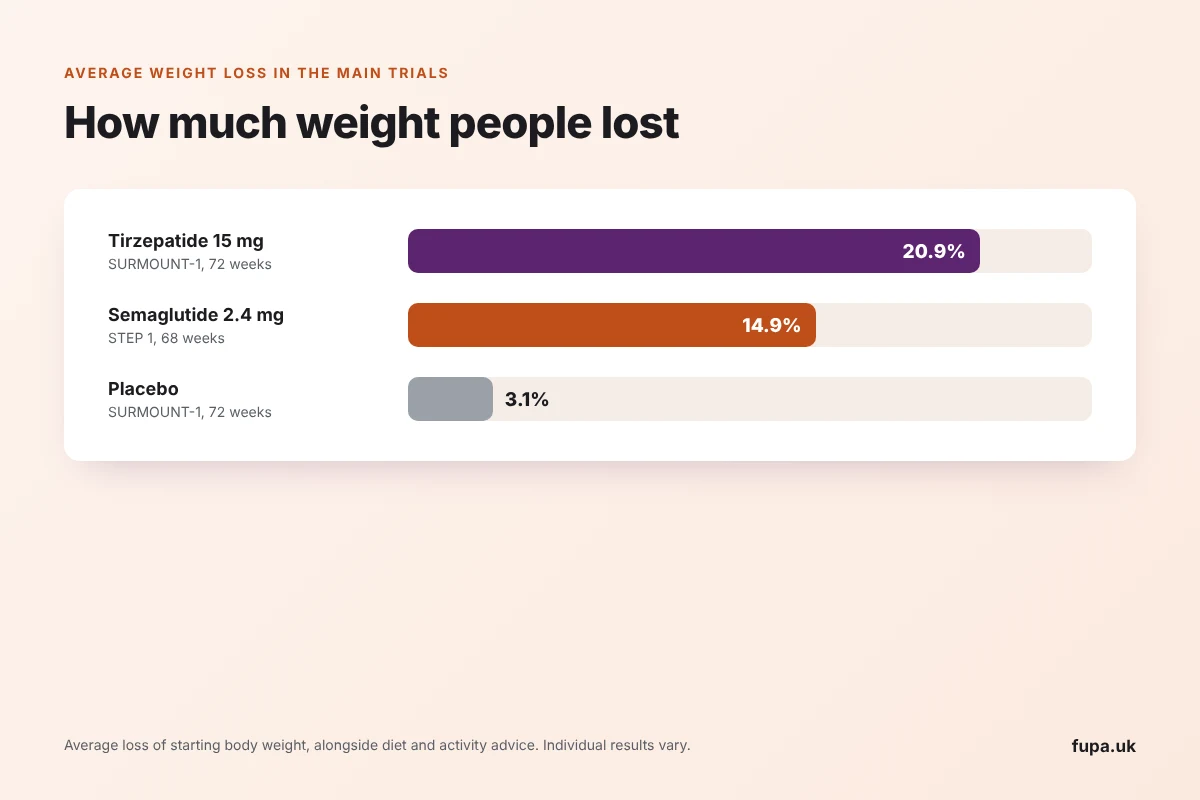
In the SURMOUNT-1 trial, adults with obesity or overweight who took the highest dose of tirzepatide (15 mg) lost an average of 20.9% of their body weight over 72 weeks, compared with 3.1% in the placebo group. In the STEP 1 trial, semaglutide 2.4 mg led to an average loss of 14.9% over 68 weeks. Both trials included advice on diet and activity alongside the medicine.
Waist size
The SURMOUNT-5 trial compared the two medicines directly in adults with obesity but without type 2 diabetes. After 72 weeks, average weight loss was 20.2% with tirzepatide and 13.7% with semaglutide, and waist size fell by an average of 18.4 cm with tirzepatide. Waist size reflects fat around the middle, including the deeper visceral fat linked to health risks.
Averages hide a wide range
These figures are averages. Some people lose much more, and some lose very little or stop early because of side effects. Trials also run for a fixed period, so they say less about what happens over many years.
What Happens to a FUPA on Weight Loss Injections?
The fat pad usually shrinks, but not first
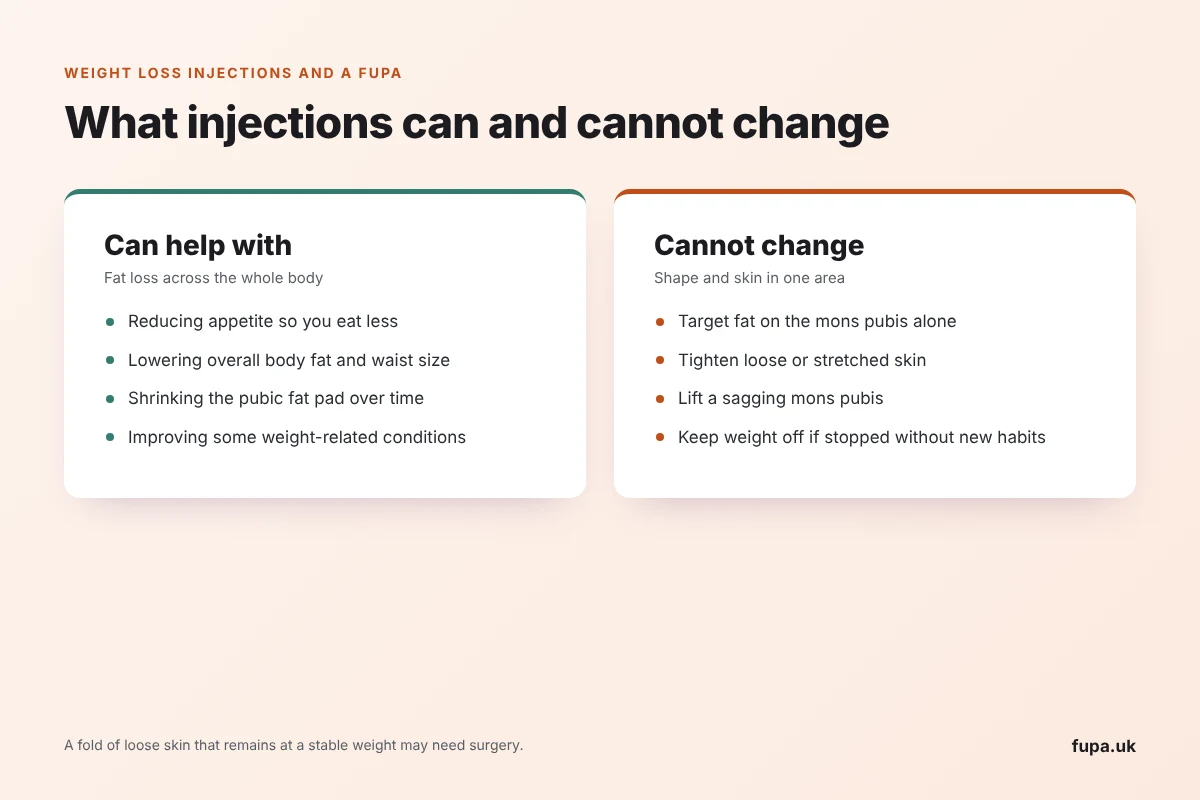
A FUPA is made mostly of subcutaneous fat sitting over the pubic bone. As your total body fat falls, this pad usually gets smaller too. Many people notice their face, arms and upper tummy change before the lower belly does, because fat in the hips and pubic area is often slower to go. Our guide to stubborn lower belly fat explains why.
Loose skin is a separate problem
Fat loss does not tighten skin. If the skin over your lower belly has been stretched for years, by pregnancy or by a higher weight, it may not shrink back fully once the fat underneath has gone. The result can be a softer, emptier fold that hangs over the pubic area. Our guide to a FUPA after weight loss explains loose skin, deflation and the options in more detail, and our page on loose skin vs fat shows how to tell them apart.
Muscle matters too
When you lose weight quickly, some of that loss can come from muscle as well as fat. The MHRA advises people taking GLP-1 medicines to keep up good nutrition and exercise to support muscle, bone and overall health. Eating enough protein and doing regular strength training helps you keep muscle while the fat comes off.
Can You Get Weight Loss Injections on the NHS?
Mounjaro from a GP
NICE has recommended tirzepatide for adults living with obesity who also have weight-related health problems. NHS England is rolling it out in GP practices and other primary care settings in phases, starting with those with the highest clinical need. In the first phase, people with a BMI of 40 or more (adjusted for ethnicity) and at least 4 of these conditions are eligible:
- high blood pressure
- abnormal blood fat levels (dyslipidaemia)
- obstructive sleep apnoea
- heart and blood vessel disease
- type 2 diabetes
People prescribed tirzepatide in primary care also get wraparound support with diet and physical activity. Not every practice offers it yet, and local criteria can differ, so check with your GP or your local integrated care board. The NHS England guide to weight management injections sets out the current rules.
Wegovy through specialist services
Semaglutide (Wegovy) is only prescribed on the NHS by a specialist weight management service. NHS England states you may be considered if you have weight-related health problems and a BMI of 35 or more, or 32.5 or more if you are of Asian, Chinese, Middle Eastern, Black African or African-Caribbean origin. People with a BMI of 30 to 34.9 (27.5 to 32.4 for those groups) may also qualify if they meet other criteria for the service. Your GP can tell you how to be referred. Our guide to NHS help to lose belly fat covers the other free routes.
Buying privately
Many people in the UK buy these injections from online pharmacies. The MHRA warns that GLP-1 medicines are prescription-only and have only been shown to be safe and effective for people with a BMI of 27 or more. Only buy from a registered UK pharmacy after a proper clinical assessment, and never from social media sellers or websites that do not ask for a prescription.
Side Effects and Safety
Common side effects
The NHS lists these common side effects of tirzepatide:
- feeling or being sick
- constipation or diarrhoea
- stomach pain
- tiredness
- itchy or red skin where you inject
- hair loss
Stomach side effects are usually worst when you start or move up a dose. Eating smaller meals and stopping when you feel full can help.
Serious side effects
Call NHS 111 if you have severe stomach or back pain that does not go away, which can be a sign of an inflamed pancreas, or severe tummy pain that could point to gallbladder problems. Call 999 for signs of a serious allergic reaction, such as a swollen throat or tongue or difficulty breathing.
Contraception, pregnancy and surgery
These medicines are not used in pregnancy or while breastfeeding. NHS England advises that tirzepatide may stop the contraceptive pill being absorbed properly, so you should use an extra method such as condoms. Always tell your surgeon and anaesthetist if you take a GLP-1 medicine before any operation, including FUPA surgery.
Injections vs Surgery for a FUPA
Side by side
| Question | Weight loss injections | FUPA surgery |
|---|---|---|
| What it treats | Excess body fat across the whole body | Fat and loose skin over the pubic area |
| Targets the FUPA? | No, it shrinks with overall fat loss | Yes, it reshapes that area directly |
| Loose skin | No effect | Can remove excess skin |
| Health benefits | Can improve weight-related conditions | Mainly cosmetic or comfort benefits |
| Timing | Months of weekly injections | Best once your weight is stable |
Why many people need both, in that order
Surgeons usually advise reaching a stable weight before any body contouring, because further weight loss can change the result. For many people, the sensible order is to lose weight first, with or without medicine, then decide whether a monsplasty or another procedure is still needed. If you are planning surgery, tell your surgeon about your weight history and any medicines you have used.
Keeping the Weight Off
What happens when you stop
In the SURMOUNT-4 trial, adults who had lost weight on tirzepatide were split into two groups after 36 weeks. A year later, 89.5% of those who kept taking it had held on to at least 80% of their loss, compared with only 16.6% of those switched to a placebo. The NHS advises talking to your doctor before stopping, as they may suggest reducing the dose gradually.
Habits that protect your results
Use the months on medication to build habits that will last: meals built around protein and vegetables, regular strength work, daily walking and enough sleep. These are the same steps in our guide on how to burn lower belly fat, and they help whether or not you use injections.
Frequently Asked Questions
Will Mounjaro get rid of my FUPA?
Mounjaro can shrink a FUPA by reducing your overall body fat, but it cannot target the pubic area. How much it changes depends on how much weight you lose and how much loose skin you have. Some people are left with a soft fold of skin that only surgery can remove.
Do weight loss injections reduce belly fat?
Yes. In trials, people taking tirzepatide or semaglutide lost body weight and waist size, which includes fat around the tummy. The fat comes off the whole body, not just the belly, and the lower belly is often one of the last areas to change.
Will weight loss injections cause loose skin on my lower belly?
The medicine does not damage skin, but any large weight loss can leave loose skin, especially if the skin was stretched for a long time or by pregnancy. Age, genetics and how much weight you lose all affect how well your skin shrinks back.
Can I get Mounjaro or Wegovy on the NHS for a FUPA?
Not for a FUPA alone. NHS prescribing is based on BMI and weight-related health conditions, not on the shape of one area. Your GP can check whether you meet the current criteria in your area.
Should I lose weight before FUPA surgery?
Usually, yes. Surgeons generally prefer you to be at or near a stable weight before body contouring, because losing a lot of weight afterwards can change the result. Tell your surgeon if you are taking, or have recently taken, a weight loss injection.
The Bottom Line
A useful tool, not a targeted fix
Weight loss injections can make a FUPA smaller by helping you lose fat from your whole body, and they can improve weight-related health conditions too. They cannot pick where the fat comes from, they will not tighten loose skin, and the weight often returns if they stop without lasting habits. If a fold remains once your weight is stable, our guide to FUPA surgery explains the next steps.