
Pilates for Lower Belly Fat: Benefits and a Beginner Routine
Page Contents
- Key Takeaways
- Can Pilates Burn Lower Belly Fat?
- Why spot reduction does not work
- What the research shows
- What Pilates Does Do for Your Lower Belly
- Stronger deep core muscles
- Better posture and a less pushed out stomach
- A low impact way to keep moving
- Mat, Reformer and Wall Pilates Compared
- Mat pilates
- Reformer pilates
- Wall pilates
- A Beginner Pilates Routine for Your Lower Belly
- Before you start
- The routine
- How to progress
- How to Make Pilates Work for Fat Loss
- Pair it with a calorie deficit
- Add cardio and strength work
- A sample week
- Pilates After Pregnancy
- When to start
- Tummy gap and lower belly shape
- Safety Tips for Pilates Beginners
- Who should get advice first
- Signs to stop or scale back
- How Long Before You See Results?
- Strength and posture
- Fat loss
- Frequently Asked Questions
- Is pilates good for lower belly fat?
- Is wall pilates good for belly fat?
- How many times a week should I do pilates to lose belly fat?
- Is pilates or yoga better for belly fat?
- Can pilates give me a flat stomach?
- The Bottom Line
- Use pilates for strength, not as a fat burner
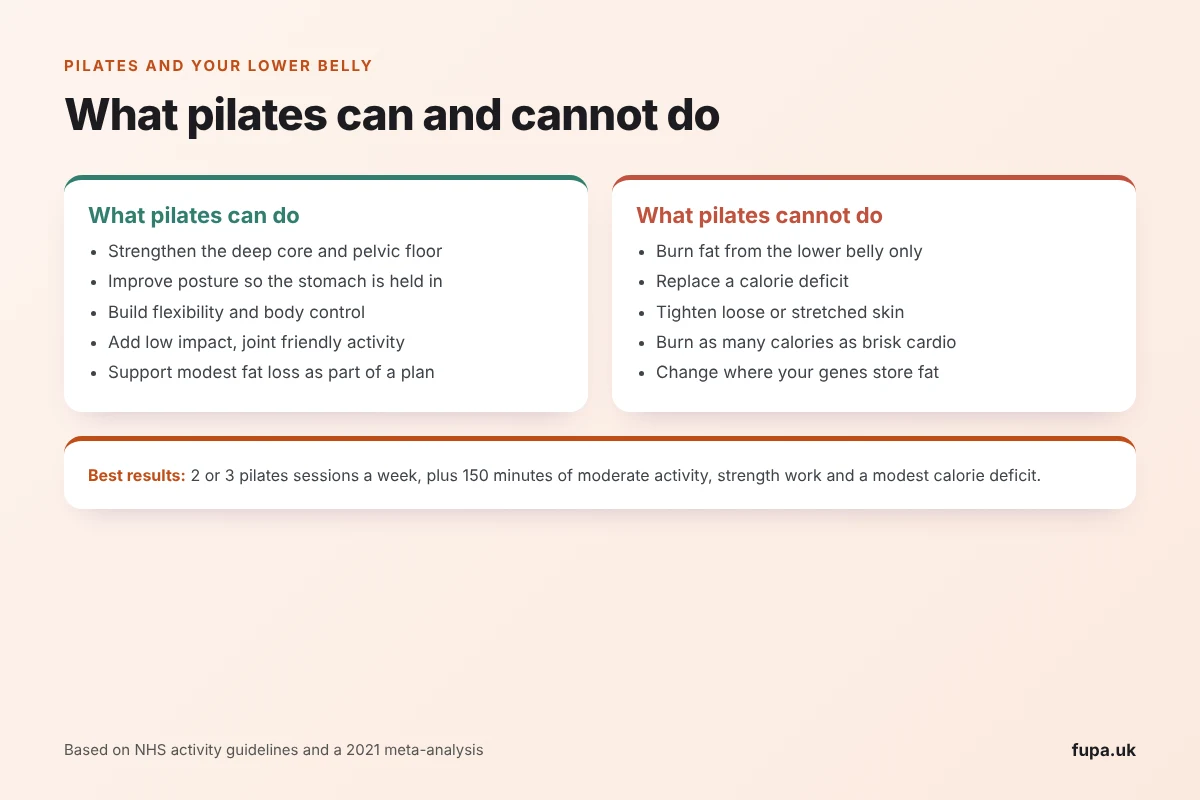
Pilates for lower belly fat is one of the most searched workout ideas in the UK, helped along by the wall pilates trend on social media. The honest answer is that pilates will not burn fat from your lower belly on its own, because no exercise can choose where your body loses fat. What pilates does well is strengthen the deep core muscles that sit behind your lower belly, improve your posture and give you a low impact way to stay active while a calorie deficit does the fat loss work.
This guide explains what the research says about pilates and fat loss, what it can and cannot change about your lower belly, how mat, reformer and wall pilates compare, and a simple beginner routine you can do at home. It is part of our wider belly fat workout plan.
Speak to your GP or a physiotherapist before starting if you are pregnant, had a baby in the last few months, had recent surgery, or have back pain or a pelvic floor problem. Stop any exercise that causes pain.
Key Takeaways
- Pilates cannot spot reduce lower belly fat. Fat loss comes from an overall calorie deficit.
- A 2021 review of 11 trials found pilates led to modest falls in body weight and body fat in adults living with overweight or obesity, but no clear change in waist size.
- Its real strengths are deep core strength, posture, flexibility and pelvic floor control, which can make your lower belly look and feel firmer.
- The NHS counts pilates as a muscle strengthening activity, which adults should do on at least 2 days a week.
- For the best results, combine 2 or 3 pilates sessions a week with cardio, strength training and a modest calorie deficit.
Can Pilates Burn Lower Belly Fat?
Why spot reduction does not work
When you exercise a muscle, your body does not take the energy from the fat sitting on top of it. Fat is released from stores all over the body, in an order largely set by your genes, sex and hormones. The lower belly and the fat pad over the pubic bone are often among the last places to slim down, which is why so many people feel stuck there. Our guide to stubborn lower belly fat explains why this area holds on for longer.
So a pilates move that makes your lower abs burn is strengthening the muscle underneath, not melting the fat above it. That is still useful, but it is a different job.
What the research shows
The best summary so far is a 2021 meta-analysis of pilates for overweight or obesity published in Frontiers in Physiology. It pooled 11 randomised controlled trials with 393 adults. Compared with control groups, people who did pilates lost on average about 2.4kg of body weight and about 4 percentage points of body fat. Weight and BMI changes were only clear in programmes longer than 10 weeks.
Two details matter for your lower belly. Only two trials measured waist size, and they showed no clear change. The authors also rated the evidence as low to moderate quality, because the studies were small and most were not blinded. In plain terms, pilates can be part of a fat loss plan, but it is not a shortcut to a flatter lower stomach.
What Pilates Does Do for Your Lower Belly
Stronger deep core muscles
Pilates focuses on the transverse abdominis, the deepest layer of your abdominal wall, which wraps around your middle like a corset. It also trains the pelvic floor, the muscles along the spine and the obliques. When these muscles are stronger, your lower belly is held in better, which can make it look flatter even before you lose fat. For more ways to train this area, see our guide to lower ab exercises.
Better posture and a less pushed out stomach
Many people with a pronounced lower belly also stand with the pelvis tipped forward, which pushes the stomach out. Pilates teaches you to find a neutral spine and pelvis, and the NHS describes it as a form of exercise that focuses on balance, posture, strength and flexibility. Our guide to FUPA and posture shows how much difference standing position can make to how your lower belly looks.
A low impact way to keep moving
Pilates is gentle on the joints and can be scaled for most bodies, ages and fitness levels. That makes it a good starting point if you are new to exercise, carrying extra weight or returning after a break. The NHS physical activity guidelines list pilates as a muscle strengthening activity, which adults should do on at least 2 days a week alongside 150 minutes of moderate activity. If you prefer a slower practice with more stretching, our guide to yoga for lower belly fat covers 8 beginner poses.
Mat, Reformer and Wall Pilates Compared
| Type | Equipment | Where | Best for |
|---|---|---|---|
| Mat pilates | Exercise mat, optional small ball or band | Home, gym or class | Beginners, low cost, learning core control |
| Reformer pilates | Sliding carriage with spring resistance | Studio | Added resistance, guided form, variety |
| Wall pilates | A clear wall and a mat | Home | Extra support and balance, easy to start |
Mat pilates
Mat pilates uses your body weight and gravity for resistance. It is the cheapest and easiest way to start, and most of the core moves in this guide come from mat work. The NHS Fitness Studio has a free 45 minute pilates for beginners video if you would like to follow an instructor at home.
Reformer pilates
A reformer is a moving carriage with springs that you push and pull against. The springs add resistance, so sessions can feel closer to strength training. Classes usually cost more than mat sessions, but an instructor will check your form, which helps if you are unsure how to engage your deep core.
Wall pilates
Wall pilates uses a wall to support your feet, back or hands during classic moves such as bridges and leg lifts. There is no separate research on wall pilates and fat loss, and it works on the same principles as mat pilates. It can be a friendly option for larger bodies or anyone who finds balance difficult, but claims that it melts belly fat in 28 days are not backed by evidence.
A Beginner Pilates Routine for Your Lower Belly
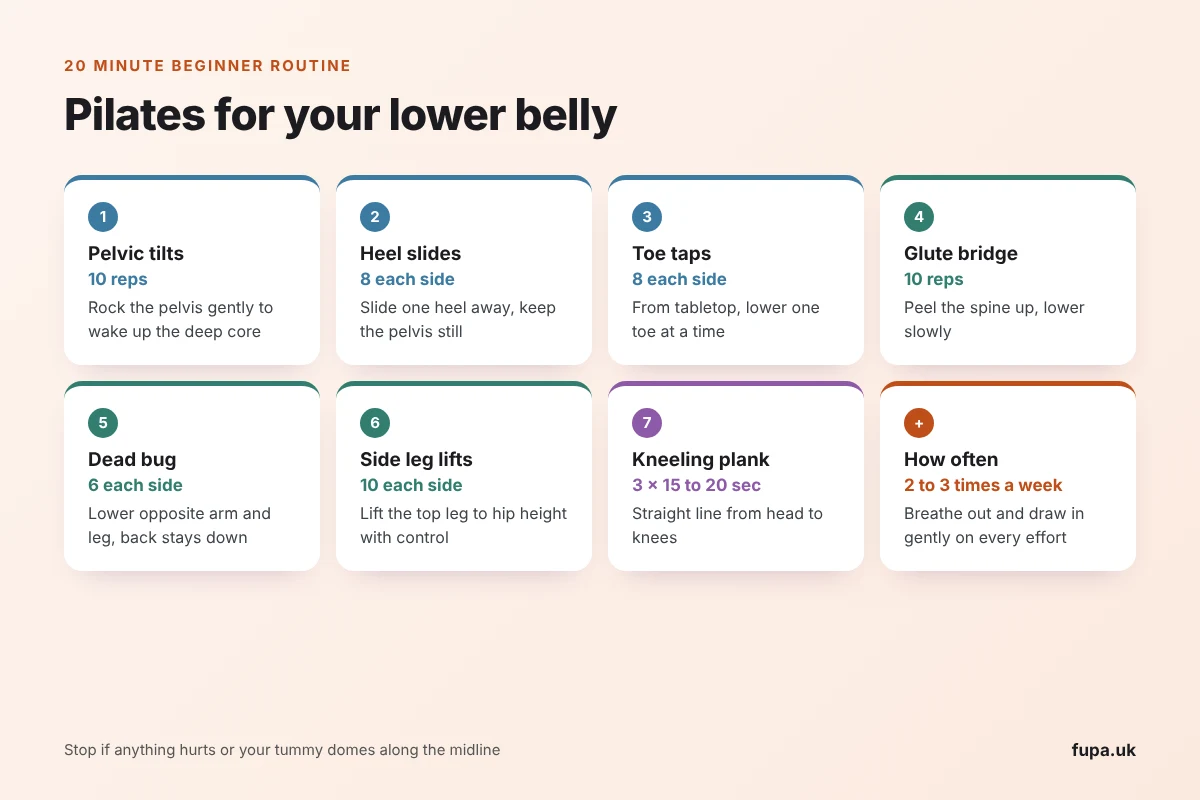
This 20 minute routine focuses on the deep core, pelvic floor and glutes. Aim for 2 or 3 sessions a week on non consecutive days. Move slowly, breathe steadily and stop if anything hurts.
Before you start
- Find neutral spine: lie on your back with knees bent and feet flat. Keep a small natural curve in your lower back, neither flattened nor arched.
- Breathe: breathe in through your nose into the sides of your ribs, then breathe out through your mouth.
- Draw in gently: as you breathe out, gently lift your pelvic floor and draw your lower belly towards your spine, at about 30 percent effort. Keep breathing while you hold it.
The routine
- Pelvic tilts, 10 reps: gently rock your pelvis to flatten then lengthen your lower back. This warms up the deep core.
- Heel slides, 8 each side: slide one heel away along the floor and back while keeping your pelvis still.
- Toe taps, 8 each side: lift your legs to tabletop, knees over hips, then lower one toe at a time to tap the floor.
- Glute bridge, 10 reps: breathe out, press through your heels and peel your spine up one vertebra at a time, then lower slowly.
- Dead bug, 6 each side: with legs in tabletop and arms reaching up, lower the opposite arm and leg towards the floor without your back arching.
- Side lying leg lifts, 10 each side: lie on your side in a straight line and lift the top leg to hip height with control.
- Kneeling plank, 3 holds of 15 to 20 seconds: forearms on the floor, knees down, body in a straight line from head to knees.
How to progress
Once the routine feels easy for two weeks, add one change at a time: extra reps, a second round, straight leg toe taps, single leg bridges or full planks. If your tummy domes or bulges along the midline during a move, go back to the easier version, as this can mean the load is too much for your deep core right now.
How to Make Pilates Work for Fat Loss
Pair it with a calorie deficit
Fat loss anywhere on your body depends on taking in a little less energy than you use over weeks and months. A modest daily deficit, enough protein and plenty of fibre will shrink your lower belly far more than any single workout. Our guide to a calorie deficit for a FUPA shows how to set yours.
Add cardio and strength work
Pilates burns fewer calories than brisk walking, cycling or running for the same time, so use it alongside cardio rather than instead of it. Heavier resistance training also helps you keep muscle while you lose fat. Our guide to strength training for belly fat explains how to fit both in.
A sample week
| Day | Session |
|---|---|
| Monday | Pilates routine, 20 to 30 minutes |
| Tuesday | Brisk walk, 30 to 40 minutes |
| Wednesday | Full body strength session |
| Thursday | Pilates routine plus a 20 minute walk |
| Friday | Cycling, swimming or another cardio you enjoy |
| Saturday | Full body strength or a pilates class |
| Sunday | Rest or gentle stretching |
Pilates After Pregnancy
When to start
NHS maternity services advise that pelvic floor exercises can usually begin in the first few days after birth. Pilates classes and other low impact exercise are generally suggested after your postnatal check at around 6 to 8 weeks, and after a caesarean you may need longer. Postnatal pilates classes are designed for this stage and start with breathing and pelvic floor work.
Tummy gap and lower belly shape
If your tummy muscles separated during pregnancy, some classic moves such as full sit ups can put too much pressure on the midline early on. Ask your midwife or GP about a referral to a women’s health physiotherapist if you notice a gap or bulge. Our guides to a FUPA after pregnancy and FUPA vs diastasis recti explain how to tell fat, loose skin and muscle separation apart. For a stage by stage plan from the first days after birth, see our guide to postnatal exercises for your lower belly.
Safety Tips for Pilates Beginners
Who should get advice first
- People who are pregnant or recently gave birth.
- Anyone with recent surgery, a hernia or a heart condition.
- People with ongoing back, hip or joint pain.
- Anyone who has not exercised for a long time and has health concerns.
Signs to stop or scale back
- Sharp pain in your back, hips or neck.
- Doming or bulging along the middle of your tummy.
- Leaking urine or a heavy feeling in the pelvis.
- Dizziness, chest pain or feeling unwell.
How Long Before You See Results?
Strength and posture
Most beginners notice better core control and posture within a few weeks of regular sessions, and many instructors suggest that changes in posture show after around 10 to 20 sessions. You may feel your lower belly is held in better before the scales move.
Fat loss
Visible fat loss from the lower belly depends on your calorie deficit and how much fat you have to lose. In the review above, clear weight changes only appeared in programmes longer than 10 weeks. Our guide on how long it takes to lose lower belly fat sets out a realistic timeline.
Frequently Asked Questions
Is pilates good for lower belly fat?
Pilates is good for the muscles under your lower belly, but it cannot burn fat from that spot. Combined with a calorie deficit and other exercise, it can support overall fat loss and help your stomach look firmer.
Is wall pilates good for belly fat?
Wall pilates works the same muscles as mat pilates with extra support from the wall. There is no evidence that it removes belly fat faster than other exercise, so treat it as core and posture training.
How many times a week should I do pilates to lose belly fat?
Two or three sessions a week is a sensible target for core strength. For fat loss, add at least 150 minutes of moderate activity a week and a modest calorie deficit.
Is pilates or yoga better for belly fat?
Neither burns much fat on its own. Pilates puts more focus on deep core strength, while yoga focuses more on flexibility and relaxation. Choose the one you will stick with and pair it with cardio and a healthy diet.
Can pilates give me a flat stomach?
Pilates can make your stomach look flatter by improving posture and tightening the deep core. A truly flat lower belly also depends on body fat, loose skin and genetics, which pilates cannot change.
The Bottom Line
Use pilates for strength, not as a fat burner
Pilates for lower belly fat works best when you see it as core and posture training that supports fat loss, not as a way to burn fat from one spot. Do the beginner routine 2 or 3 times a week, keep moving every day and eat in a modest calorie deficit. For the full plan, see our guide on how to burn lower belly fat.