
Lower Belly Fat After 40: Why It Changes and What to Do
Page Contents
- Key Takeaways
- Why Belly Fat Changes After 40
- Your metabolism is not the main culprit
- Gradual muscle loss
- Lifestyle drift
- Belly Fat After 40 in Women: Perimenopause
- What changes in perimenopause
- Why fat moves to the belly
- Other signs it may be perimenopause
- Belly Fat After 40 in Men
- Testosterone falls slowly
- Men store more visceral fat
- When to get a blood test
- How to Lose Belly Fat After 40
- Strength train at least twice a week
- Eat enough protein and fibre
- Move more every day
- Use a modest calorie deficit
- Look after sleep, stress and alcohol
- Lower Belly Fat After 40: What Is Realistic
- The lower belly is usually last to change
- Loose skin and pregnancy changes
- When to see a GP
- Frequently Asked Questions
- Why am I gaining belly fat after 40?
- Is it harder to lose belly fat after 40?
- Does perimenopause cause belly fat?
- What is the best exercise for belly fat after 40?
- Can HRT help with menopause belly fat?
- The Bottom Line
- Build muscle and steady habits
Belly fat after 40 is one of the most common body changes people notice in midlife. Your weight may barely move, yet your waistband gets tighter and the lower belly looks softer than it did a few years ago. A slowing metabolism usually gets the blame, but the research points to other causes: gradual muscle loss, falling activity, changes in sleep and stress, and, for women, the hormone shifts of perimenopause.
This guide explains why fat moves towards the belly after 40 in both women and men, what is realistic to change, and a simple plan for your 40s and 50s. It is part of our hub on hormonal belly fat.
This guide is general information, not medical advice. See your GP if your belly is growing quickly, feels firm or swollen, or comes with other symptoms such as bloating that does not go away, changes in your periods or bleeding after the menopause.
Key Takeaways
- Your metabolism stays fairly stable between the ages of 20 and 60, so it is rarely the main reason for belly fat in your 40s.
- Muscle slowly declines from your 30s onwards, and activity often drops, which together lower the energy you use each day.
- For women, the NHS says weight gain is common in perimenopause and menopause and often settles around the stomach.
- For men, testosterone falls slowly with age, and extra belly fat is more likely to be the deeper visceral type.
- Strength training, protein, daily movement, good sleep and a modest calorie deficit work at any age.
Why Belly Fat Changes After 40
Your metabolism is not the main culprit
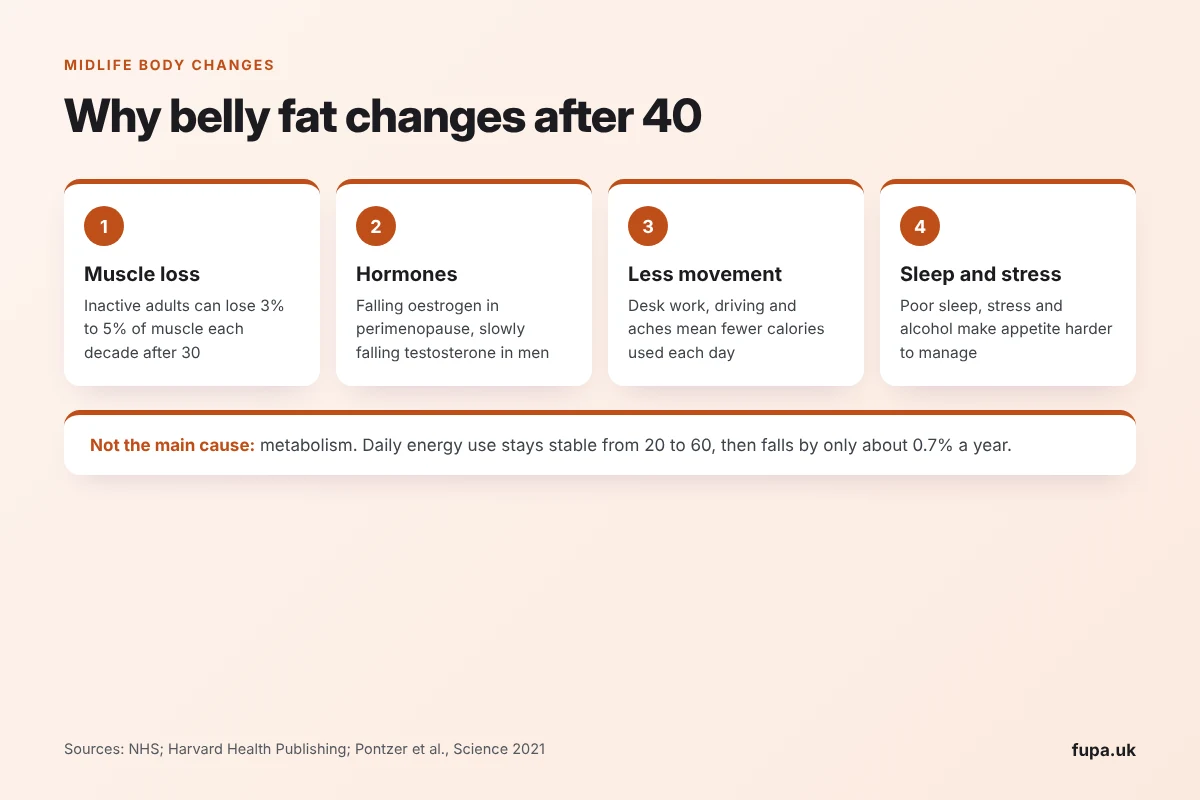
A large 2021 study published in Science measured daily energy use in more than 6,600 people aged from one week to 95 years across 29 countries. After adjusting for body size, energy expenditure was remarkably stable from the age of 20 to 60. It only started to fall after 60, and then slowly, at about 0.7% a year. In other words, most of the midlife change in shape comes from what we do and how our bodies are built, rather than a sudden slowdown.
Gradual muscle loss
Muscle uses more energy than fat, even at rest. Harvard Health Publishing notes that after the age of 30, inactive adults can lose as much as 3% to 5% of their muscle mass each decade. Less muscle means slightly fewer calories burned each day and a softer look around the middle, even if your weight stays the same.
Lifestyle drift
Many people move less in their 40s because of desk jobs, driving, family duties or aches and pains. Sleep often gets worse, stress can rise, and alcohol intake tends to creep up. Each of these makes appetite harder to manage. Our guides to sleep and stress and cortisol explain how they affect the lower belly.
Belly Fat After 40 in Women: Perimenopause
What changes in perimenopause
Menopause usually happens between the ages of 45 and 55, and the average age in the UK is 51. Perimenopause is the time before this, when hormone levels start to change and symptoms begin while you still have periods. According to the NHS, weight gain during perimenopause and menopause is common and often happens around the stomach and upper body.
Why fat moves to the belly
Before the menopause, oestrogen tends to direct fat towards the hips and thighs. As oestrogen falls, more fat is stored around the abdomen, including the deeper visceral fat. This is why many women notice their shape changing from a pear towards an apple, even without much weight gain. Our guide to a FUPA and the menopause covers the lower belly after periods stop.
Other signs it may be perimenopause
Changes in your periods, hot flushes, night sweats, poor sleep, low mood, brain fog and joint aches are all common. If symptoms are affecting your daily life, talk to your GP. Hormone replacement therapy (HRT) can ease symptoms for many women, but it is a treatment for symptoms rather than a weight loss treatment.
Belly Fat After 40 in Men
Testosterone falls slowly
The NHS explains that testosterone levels fall steadily with age, by less than 2% a year from around the age of 30 to 40, and that this alone is unlikely to cause problems. Gaining belly fat can itself lower testosterone, so the two often go together. Our guide to a FUPA and testosterone explains the link.
Men store more visceral fat
Men are more likely to store fat deep inside the abdomen, which is the type linked with type 2 diabetes and heart disease. A simple check is to keep your waist measurement below half your height. Our guide on whether lower belly fat is dangerous shows how to measure it.
When to get a blood test
A small number of men develop low testosterone later in life, often linked with obesity or type 2 diabetes. If you have low sex drive, erection problems, low mood and tiredness together, your GP can check your testosterone with a blood test.
| Driver | Women after 40 | Men after 40 |
|---|---|---|
| Main hormone change | Falling oestrogen in perimenopause and menopause | Slow fall in testosterone |
| Where new fat tends to go | Shifts from hips and thighs towards the stomach | Mainly deep visceral fat around the organs |
| Muscle loss | Gradual, can speed up after menopause | Gradual, faster with inactivity |
| Best first step | Strength training plus symptom support from your GP | Strength training and cutting back on alcohol |
How to Lose Belly Fat After 40
Strength train at least twice a week
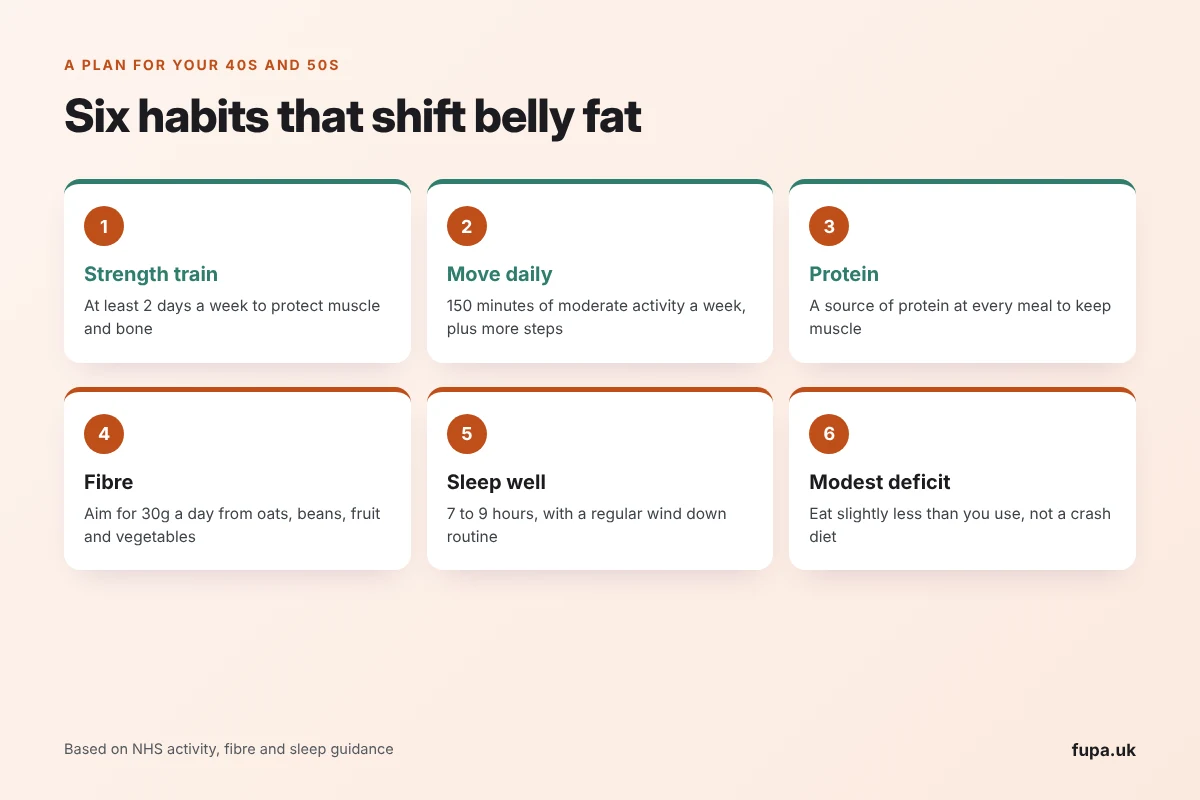
Strength training is the most useful change you can make after 40. It protects muscle, supports your bones, which matters after the menopause, and helps your body use more energy. The NHS advises strength work on at least 2 days a week. Our guide to strength training for belly fat has a simple routine for beginners.
Eat enough protein and fibre
Protein helps you keep muscle and stay full, and fibre helps control appetite and blood sugar. Include a source of protein at each meal and aim for the NHS target of 30g of fibre a day. Our guides to protein for fat loss and fibre and belly fat give practical food swaps.
Move more every day
Aim for at least 150 minutes of moderate activity a week, such as brisk walking, cycling or swimming. Everyday movement counts too: walking to the shops, taking the stairs and standing up regularly at work all add up.
Use a modest calorie deficit
Fat loss at any age needs you to take in slightly less energy than you use. A small deficit you can keep up is better than a strict diet that leaves you tired and loses muscle. Our guide to a calorie deficit for a FUPA shows how to start.
Look after sleep, stress and alcohol
Aim for 7 to 9 hours of sleep, find a regular way to wind down, and keep alcohol within the UK guideline of no more than 14 units a week, spread over several days. These habits make hunger easier to manage and support every other part of the plan.
Lower Belly Fat After 40: What Is Realistic
The lower belly is usually last to change
Lower belly fat after 40 often shrinks more slowly than fat elsewhere. Many people see their waist and visceral fat improve first, with the area over the pubic bone following months later. Track progress with a tape measure every 2 to 4 weeks rather than relying on the mirror. Our guide on how long it takes to lose lower belly fat sets out a realistic timeline.
Loose skin and pregnancy changes
Skin becomes less elastic with age, and pregnancies can stretch the lower belly. Some of the softness you see may be loose skin rather than fat, which exercise cannot tighten. Our guide to loose skin vs fat on the lower belly explains how to tell them apart.
When to see a GP
See your GP if your belly grows quickly without an obvious reason, feels hard, or you have ongoing bloating, pain, changes in bowel habits, unexpected bleeding or weight loss you cannot explain. These need checking rather than a diet. Our guide to a FUPA vs bloating covers the difference.
Frequently Asked Questions
Why am I gaining belly fat after 40?
Belly fat after 40 is usually caused by a mix of gradual muscle loss, moving less, poorer sleep, stress and alcohol. For women, falling oestrogen in perimenopause also shifts fat towards the stomach. Metabolism itself stays fairly stable until about 60.
Is it harder to lose belly fat after 40?
It can feel harder because muscle declines and hormones change, but the same approach still works. Strength training, enough protein, regular activity and a modest calorie deficit reduce belly fat at any age.
Does perimenopause cause belly fat?
The NHS says weight gain is common during perimenopause and menopause and often happens around the stomach. Falling oestrogen means more fat is stored around the abdomen rather than the hips and thighs.
What is the best exercise for belly fat after 40?
A mix works best: strength training on at least 2 days a week to protect muscle, plus at least 150 minutes of moderate activity such as brisk walking, cycling or swimming. No single exercise burns belly fat on its own.
Can HRT help with menopause belly fat?
HRT treats menopause symptoms such as hot flushes and poor sleep, which can make healthy habits easier to keep up. It is not a weight loss treatment. Talk to your GP about whether it is right for you.
The Bottom Line
Build muscle and steady habits
Belly fat after 40 is common, but it is not inevitable. The main drivers are muscle loss, less movement and, for women, the hormone changes of perimenopause, rather than a broken metabolism. Strength train twice a week, eat enough protein and fibre, stay active every day, sleep well and keep a modest calorie deficit. For more on how hormones shape your waistline, see our guide to hormonal belly fat.