Endo Belly vs FUPA: How to Tell Them Apart
Page Contents
- Key Takeaways
- What Is Endo Belly?
- Endometriosis in brief
- What endo belly looks and feels like
- Why it happens
- What Is a FUPA?
- A pad of fat over the pubic bone
- How a FUPA behaves
- Endo Belly vs FUPA: The Main Differences
- Side by side
- The timing test
- The pinch test
- Other Signs That Point to Endometriosis
- Symptoms around your period
- Symptoms at any time
- Conditions that can look similar
- How Endometriosis Is Diagnosed
- Your GP appointment
- Scans and laparoscopy
- Why diagnosis can take time
- What Helps Each One
- Managing endo belly
- Reducing a FUPA
- When you have both
- When to See a GP
- Book a routine appointment if
- Get urgent help if
- Frequently Asked Questions
- What is endo belly?
- How can I tell if my belly is endo belly or fat?
- Can endo belly make you look pregnant?
- Will losing weight get rid of endo belly?
- How long does endo belly last?
- The Bottom Line
- Trust the pattern, not a single mirror check
Endo belly is the name many people with endometriosis use for the painful, swollen tummy that can appear in a matter of hours and then settle again. A FUPA is a soft pad of fat over the pubic bone that stays much the same from morning to night. Both sit on the lower belly, so it is easy to confuse them, especially if you have both. The key difference is simple: endo belly comes and goes, while fat does not.
This guide explains what endo belly is, how it differs from a FUPA, the other symptoms of endometriosis to look out for, and when to see a GP. It is part of our guide to hormonal belly fat and related conditions.
This guide is general information, not medical advice. It cannot diagnose endometriosis or any other condition. If you have pelvic pain, painful periods or a swollen tummy that worries you, speak to your GP.
Key Takeaways
- Endo belly is swelling and bloating linked to endometriosis. It often builds over hours, can be painful and tends to ease again, especially around periods.
- A FUPA is fat over the pubic bone. It feels soft, can be pinched, is usually painless and changes only slowly with weight.
- Endometriosis UK estimates that around 1.5 million people in the UK have endometriosis.
- Diet and exercise can reduce a FUPA over time, but they will not cure endometriosis. Endo belly needs medical assessment and symptom management.
- See a GP if pain, heavy periods or bloating affect your daily life, or if your tummy is swollen on most days.
What Is Endo Belly?
Endometriosis in brief
The NHS endometriosis page describes endometriosis as a condition where cells similar to those in the lining of the womb grow in other parts of the body. It is often found around the womb, ovaries, fallopian tubes and the lining of the pelvis, and sometimes on the bladder or bowel. Symptoms happen when these patches break down and bleed but cannot leave the body, which can cause inflammation, pain and scar tissue.
What endo belly looks and feels like
Endo belly is not a medical diagnosis but a description people use for marked bloating and swelling of the tummy. The lower belly may look rounded or tight, clothes that fitted in the morning may feel uncomfortable by the evening, and some people say they look several months pregnant. The swelling often feels firm or tender rather than soft, and it may come with cramping or aching.
Why it happens
The exact cause is not fully understood. Inflammation in the pelvis, endometriosis on or near the bowel, and the hormonal changes of the menstrual cycle are all thought to play a part. Endometriosis UK notes that many people with endometriosis have marked bloating around the time of a period, while also pointing out that bloating is common without endometriosis too.
What Is a FUPA?
A pad of fat over the pubic bone
A FUPA is a build up of fat on the mons pubis, the area just above the pubic bone. It is made of subcutaneous fat, the soft fat that sits under the skin, sometimes with some loose skin after weight loss or pregnancy. Our guide to what a FUPA is explains the anatomy in more detail.
How a FUPA behaves
A FUPA looks much the same first thing in the morning as it does at night. It feels soft and squashy, you can pinch it between your fingers, and it is usually painless unless the skin rubs or gets sore. It grows or shrinks slowly, over weeks and months, as your overall body fat changes.
Endo Belly vs FUPA: The Main Differences
Side by side
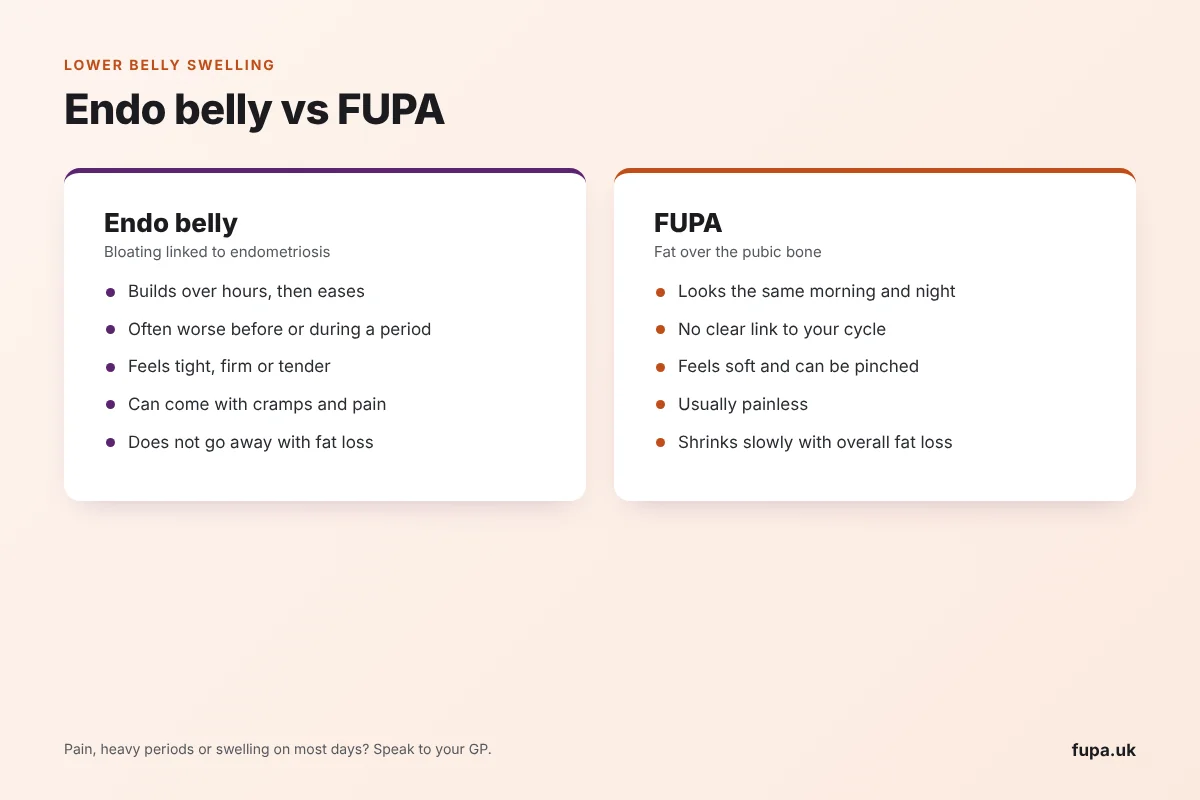
| Feature | Endo belly | FUPA |
|---|---|---|
| What it is | Bloating and swelling linked to endometriosis | Fat stored over the pubic bone |
| Through the day | Often builds over hours, then eases | Much the same morning and night |
| Link to periods | Often worse before or during a period | No clear link to the cycle |
| How it feels | Tight, firm or tender, often with pain | Soft, squashy and usually painless |
| Where it sits | Across the lower and middle tummy | Just above the pubic bone |
| Response to weight loss | Does not go away with fat loss | Shrinks slowly with overall fat loss |
The timing test
The simplest check is to compare your tummy first thing in the morning with the same view in the evening, and across different days of your cycle. A belly that is flat or much smaller in the morning and swollen later, or one that balloons in the days around a period, points to bloating rather than fat. A soft pad that looks the same every time points to a FUPA. Many people notice both: a steady FUPA with bloating that comes and goes on top.
The pinch test
Fat is soft and you can gently pinch it. Bloating from gas or swelling in the bowel usually makes the tummy feel tight and drum-like, and you cannot pinch it in the same way. If your lower belly is hard, tender or painful to press, mention it to your GP rather than assuming it is fat.
Other Signs That Point to Endometriosis
Symptoms around your period
The NHS lists severe period pain that stops you doing normal activities, and heavy periods where you need to change pads or tampons every 1 to 2 hours, as common symptoms. Our guide to the FUPA and the menstrual cycle explains how normal cycle changes affect the lower belly.
Symptoms at any time
Other symptoms the NHS lists include:
- pain in your lower tummy and back
- pain when you poo or pee
- pain during or after sex
- extreme tiredness
- difficulty getting pregnant
- low mood or anxiety
Bowel symptoms such as bloating, constipation or diarrhoea are also common, which is one reason endometriosis is sometimes mistaken for irritable bowel syndrome.
Conditions that can look similar
The NHS notes that endometriosis symptoms can be similar to adenomyosis, fibroids, pelvic inflammatory disease and irritable bowel syndrome. If your lower belly is firm and steadily growing, our guide on whether it is fibroids or belly fat explains the differences. For everyday bloating from food and wind, see our guide to a FUPA vs bloating.
How Endometriosis Is Diagnosed
Your GP appointment
A GP will ask about your symptoms and whether close relatives have had endometriosis. They may offer a physical examination of your tummy and pelvis and blood tests, and they may refer you to a gynaecologist or offer medicines to help with symptoms.
Scans and laparoscopy
Further tests can include an ultrasound scan, on the tummy or inside the vagina, and an MRI scan. The NHS explains that a laparoscopy, where a camera is passed through a small cut in the tummy, can confirm endometriosis, and areas of endometriosis can sometimes be removed during the same procedure. A normal scan does not always rule endometriosis out.
Why diagnosis can take time
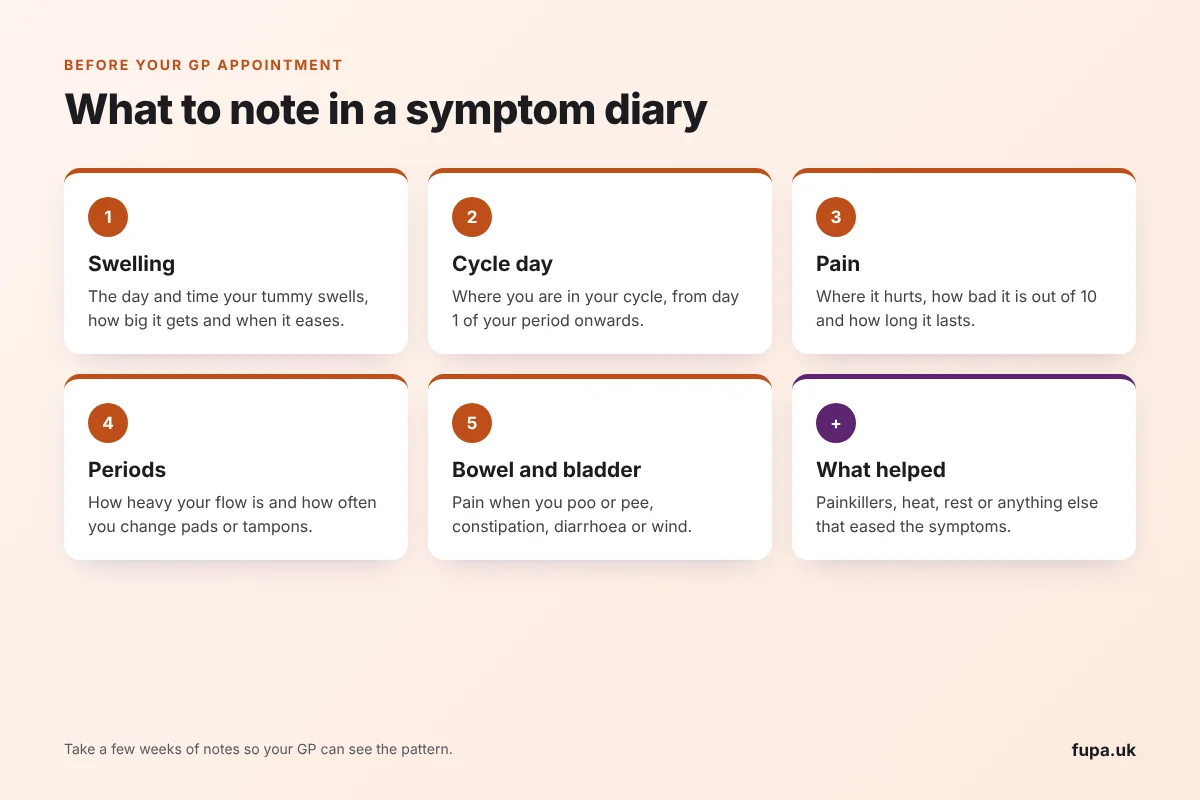
Endometriosis UK’s diagnosis survey found an average wait of 8 years and 10 months from first symptoms to diagnosis in England and Scotland. Keeping a symptom diary helps. Note the days your tummy swells, how long it lasts, where you feel pain, and where you are in your cycle, and take it to your appointment.
What Helps Each One
Managing endo belly
There is no cure for endometriosis, but treatment can help manage symptoms. The NHS lists painkillers such as paracetamol and ibuprofen, hormone treatments such as the combined contraceptive pill, and surgery to remove areas of endometriosis when other treatments do not help. Day to day, many people find loose, soft waistbands, heat on the tummy, gentle movement and rest help them get through a flare. If you think certain foods trigger bloating, talk to your GP or a registered dietitian before cutting out whole food groups.
Reducing a FUPA
A FUPA responds to the same steps that reduce body fat anywhere: a modest calorie deficit, regular activity, strength training, good sleep and time. Our guide on how to get rid of a FUPA sets out a realistic plan. These habits are good for general health with endometriosis too, but they will not stop endo belly flares on their own.
When you have both
Plenty of people have a FUPA and endometriosis at the same time. Treat them as two separate issues: manage the endometriosis with your GP or specialist, and work on body fat slowly and kindly if that matters to you. Judge progress on fat loss using measurements taken at the same point in your cycle, not on how your tummy looks during a flare.
When to See a GP
Book a routine appointment if
- you think you might have endometriosis
- pain, heavy periods or bloating are affecting your work, relationships or daily life
- treatment from a GP has not helped, or your symptoms are getting worse
- your tummy is swollen or bloated on most days, or you keep feeling full quickly
Get urgent help if
Call 111 or get urgent medical help if you have sudden, severe tummy or pelvic pain, pain with a high temperature, heavy bleeding that soaks through pads very quickly, or you feel faint or very unwell. Call 999 in an emergency.
For support, Endometriosis UK runs a free helpline on 0808 808 2227, along with online support groups.
Frequently Asked Questions
What is endo belly?
Endo belly is a term people with endometriosis use for painful bloating and swelling of the tummy. It often builds up over hours or days, is frequently worse around a period and then eases again, unlike fat, which stays the same.
How can I tell if my belly is endo belly or fat?
Compare your tummy in the morning and the evening and across your cycle. Endo belly comes and goes and often feels tight or tender, while a FUPA is soft, pinchable, painless and looks the same every day.
Can endo belly make you look pregnant?
Yes. Many people with endometriosis describe their bloating as making them look several months pregnant during a flare. The swelling usually settles again, which is one way to tell it apart from fat.
Will losing weight get rid of endo belly?
No. Weight loss can reduce a FUPA and other belly fat, but endo belly is caused by endometriosis and inflammation, not by fat. It needs medical assessment and symptom management with your GP or specialist.
How long does endo belly last?
It varies from person to person. For some it lasts a few hours, for others several days, often around a period. Recording how long each episode lasts in a symptom diary helps your GP understand your pattern.
The Bottom Line
Trust the pattern, not a single mirror check
Endo belly and a FUPA can sit in the same place but behave very differently. Swelling that comes and goes, tightness, pain and a link to your periods point to endo belly and are worth discussing with your GP. A soft pad over the pubic bone that never changes from morning to night is a FUPA, which responds slowly to fat loss. For other causes of a swollen lower tummy, see our guide to FUPA vs other belly fat and our hub on hormonal belly fat.